
In the age of AI, ERP is shifting from "buying" to "creating" — the shortest route.
Open-source ERP and AI make in-house development of core systems a realistic solution. Purchase the Python-based ERPNext source code and cultivate your own ERP system through AI pair programming—the shortest route to success. Includes safety features through test code and ongoing support.
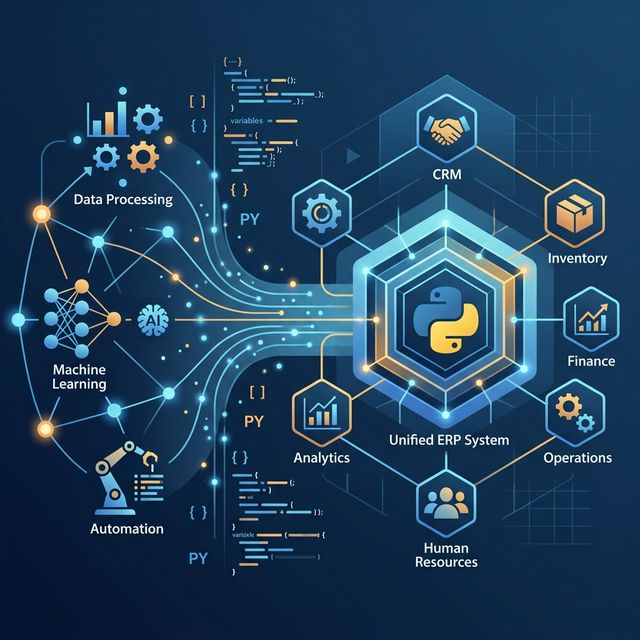
AI is changing how ERP systems are built.
Since 2024, the accuracy of code generation AI has reached a level that is suitable for practical use.
You can feed an existing codebase into the AI and give it natural language instructions like, "I want to change this process," or "I want to add this item to this screen," and it will generate working code. It's not perfect, and reviews are necessary. But the development speed has definitely changed.
What this change means is that "in-house development" of core systems is no longer something only large corporations can do.
However, for AI to be effective, you need to have the source code at hand. Even if you're using drag-and-drop on a SaaS UI, you won't really get the benefits of AI. The gap between those who possess the source and those who do not will only widen in the future.
Why "ERPNext × Python"?
ERPNext is an open-source ERP system developed by Frappe, an Indian company, and is commercially used worldwide. It offers a full range of ERP functions, including accounting, sales, purchasing, inventory, manufacturing, and human resources.
The reason why it's attracting attention as an in-house ERP system for the AI era lies in its technology stack.
| Language | ERP System Used | Compatibility with AI Development |
|---|---|---|
| Python | ERPNext | Highly readable and excellent compatibility with AI libraries |
| Java | SAP (partial), Openbravo | Type-safe but large code volume |
| C# | Microsoft Dynamics | Windows-centric ecosystem |
| ABAP | SAP | Proprietary language. Extremely high learning curve. |
While Java, C#, or proprietary languages like ABAP are prevalent in the ERP world, ERPNext is built using standard languages from the web.
When speaking with potential customers, we frequently hear them say, "I like that it's written in Python." They appreciate the high readability of the code and the ability to write code that directly expresses what they want to do. We're also seeing an increasing number of companies with in-house personnel who are proficient in Python.
Furthermore, the productivity of the Frappe framework is also a notable feature. Simply by defining the DocType (data model), CRUD screens, REST APIs, and permission management are automatically generated.
However, we are far from zero.
ERPNext is a powerful framework, but it's not like you can just say, "Okay, let's build our own ERP system tomorrow" and get started right away.
Understanding the Frappe framework, its unique DocType design, hook mechanism, and permission model—just going through this cycle can take several months.
In addition, there are measures unique to Japan.
| Issues | Content | Global Version Support |
|---|---|---|
| Consumption Tax | Rounding, Reduced Tax Rate, Invoice System | Almost Not Supported |
| Forms | Japanese-style invoice and delivery note format | Overseas specifications only |
| Business Practices | Customer Code System, Closing and Payment Terms | Not Supported |
| Japanese | Menu/Message Translation Quality | Incomplete |
In other words, there is still a long way to go between what I want to do and being able to do it. This is the point where many companies feel they "want to do it in-house, but can't take the plunge."
The ERPNext.JP Source Package as an Option
To bridge this gap, we have prepared the ERPNext.JP source package.
We provide an environment and complete source code set tailored to Japanese business practices. This is something that has been used extensively in actual business operations, modified, and improved. You can run it in your company's environment the moment you acquire it, and you can also feed it to AI to help it understand its structure.
For detailed information about the package (what is provided, support services, terms of use, etc.), please see below. Launching pad for in-house ERP development — ERPNext.JP source package We introduce it here.
This article will focus on the practical aspects of in-house development utilizing AI.
Practical Aspects of AI Pair Programming
Having the source code at hand concretely changes how we collaborate with AI. Here are a few examples.
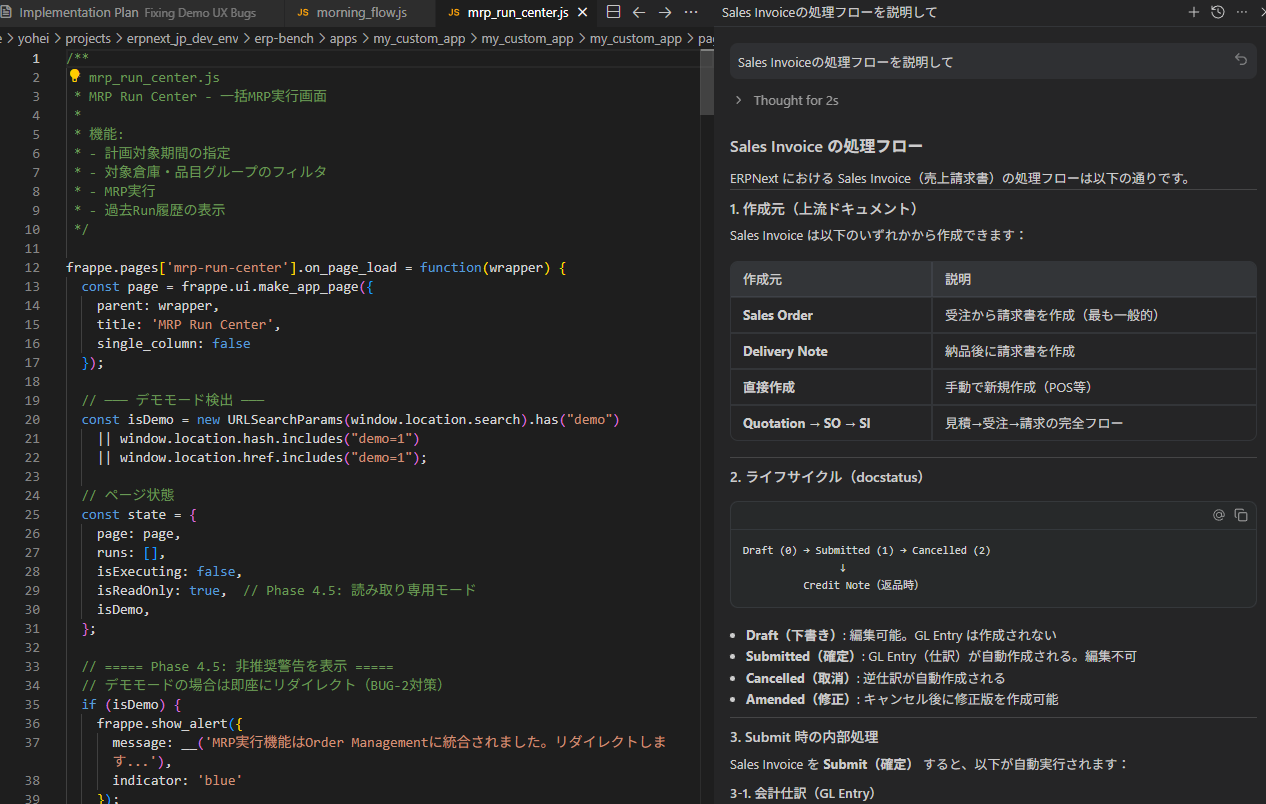
💡 Understanding the code
If you ask the AI to "explain the entire processing flow for this sales invoice," it will analyze the relevant Python code, hooks, and server scripts across the board and explain the process flow in Japanese. New members will be able to catch up on the system much faster.
🔧 New Feature Added
"Add a field to the order screen that displays the customer's credit balance in real time"—the AI can output requirements like this as code that follows Frappé's conventions. Of course, functionality testing and review are necessary, but the time required is drastically different from writing the code from scratch.
🧪 Testing and Debugging
AI can handle tasks such as generating test cases for existing code, investigating the root cause of errors, and suggesting refactoring solutions. This allows development teams to dedicate more time to designing the business processes that truly matter.
All of this is only possible because you have the source code at hand. This way of working is not possible in a SaaS environment.
Test Code as a Safety Mechanism
It's understandable to have concerns about letting AI write code. "Inadvertently breaking existing processes" is the last thing you want to happen in AI development.
The ERPNext.JP source package includes a set of test code that covers core business processes such as accounting, inventory allocation, sales flow, and purchasing flow. The code generated by the AI is tested before being deployed to production. If it fails, we can find out what broke. We can also revert the code back to the AI and have it fix it.
Test code is the guardrail in AI development. This creates a system that allows us to actively, yet safely, utilize AI, rather than using it with trepidation. Writing tests from scratch alone would require a considerable amount of effort, but that's already taken care of.
It can also keep up with updates to the ERPNext main unit.
There's one more important point.
ERPNext is an open-source project that is actively under development, with security patches and feature improvements being released continuously.
Even if you fork your own company, you won't be isolated.
Even if you develop your own fork based on the source package, you can maintain a system that allows you to incorporate updates to the ERPNext core. Frappe's custom app architecture is designed to allow for both core customization and adherence to upstream development. Even if a security vulnerability is discovered, it can be quickly addressed by installing a patch on the main unit.
Start with the team that knows ERPNext best in Japan
There is another important factor to consider when moving forward with the in-house development of AI x ERPNext. "Whether or not you have someone you can ask for help when you're in trouble."
The ERPNext.JP operating team is comprised of members who are the most knowledgeable about ERPNext in Japan. I have a track record of contributing Japanese translations to the ERPNext core system and over two years of experience in building and operating it in a real-world environment.
Based on our knowledge of the Frappe framework's design philosophy, pitfalls not mentioned in the official documentation, and know-how for applying it to Japanese business practices, we will provide hands-on support for your company's in-house AI development.
Terms of Use
The source package is for internal use only. We do not allow resale or implementation by other companies in a system integration (SIer) capacity. For more details Launching pad for in-house ERP development — ERPNext.JP source package Please take a look.
Criteria for determining if this plan is suitable
This is suitable for companies with the following policies:
- "We want to accelerate development with AI" — We have or plan to hire people who can write Python in-house.
- "We want to own our own source code." — We want to break free from SaaS dependence and take control ourselves.
- "We don't have time to build all the ERP functions from scratch." — We want to use a working system as a base and only handle the differences ourselves.
Conversely, if you have no interest in AI development and prefer traditional contract development, this plan is not suitable for you. We provide the starting point for developing your own ERP system using AI as a weapon.
Inquiry about source packages
"We're interested in developing our own ERP system, but is it realistic for a company of our size?"
Why not start with a 30-minute online consultation?
Related Articles
- What is Open Source ERP? A thorough comparison of its mechanisms, benefits, and five major products. - Launching pad for in-house ERP development — ERPNext.JP source package - Why choose open-source ERP? - Frappe Framework — Understanding the Foundation of ERPNext