
Q&A Guide
This is a comprehensive FAQ that organizes frequently asked questions about ERPNext and ERPNext.JP by implementation phase, theme, and actual challenges.
🔍 Search questions by keyword
All categories — 120
Yes, it is possible. ERPNext.JP offers data migration support from existing systems as part of its "Implementation Support Plan." It comes standard with import functions for master data (items, customers, BOM, etc.) and transaction data, and also supports bulk import from CSV and Excel files. The scope and procedure of the migration will be discussed and proposed during the free demo or the PoC (pilot).
ERPNext.JP operates on a high-performance infrastructure environment (12GB memory, 6 CPU cores, 1TB SSD) and comes standard with regular backup and disaster recovery systems. Communication is encrypted with SSL/TLS, and information leakage risks are minimized through user-specific permission settings and role-based access control. Furthermore, because the ERPNext core is open source, transparency of the source code is guaranteed. Should a critical vulnerability be identified, we notify all customers regardless of contract status (remediation is covered within the contract scope; out-of-contract cases are handled on a spot basis).
ERPNext.JP hands over the full source code, so there is no monthly usage contract or minimum period for the software. The maintenance subscription (annual maintenance contract) is recommended from the first year to keep the system updated and secure, with terms and fees set individually based on operation. Before committing, you can verify fit with a 14-day free demo and a fixed-scope PoC. Contact us for pricing.
There is no limit to the number of accounts. Everything is included in the basic fee, and there are no additional costs even if the number of users increases. You can issue as many accounts as you need, for all employees, part-timers, and staff from partner companies.
Yes, it comes equipped with a wealth of features for the manufacturing industry. It includes standard features essential for manufacturing sites, such as multi-level BOM deployment (up to 5 levels), MRP (Material Requirements Planning), lot/batch management, manufacturing performance input via barcode scanning, equipment scheduler (Gantt chart), and full process traceability. Furthermore, it supports Japanese manufacturing business practices, including Kanban system, internal order management, and customer part number support.
Yes, flexible customization is possible. ERPNext is based on the concept of "unbreakable customization" and offers a wealth of extension options such as custom fields, custom scripts, and custom applications. We provide flexible customization support on a time-based billing system, including report creation and modification, screen UI adjustment, and workflow construction tailored to your business flow. We will provide you with an estimated man-hours and cost before starting work, so you can rest assured regarding costs.
Yes, we support it. You can use it with confidence even in industries that still receive a lot of fax orders, including food processing, supermarkets, and wholesalers. ERPNext.JP can process faxes electronically (converting to PDF), read them using AI-powered OCR, and automatically register them as order data in a single, seamless process. This significantly reduces transcription errors and input time caused by manual data entry, allowing you to smoothly start using ERP even in workplaces that receive a lot of fax orders.
Rest assured. ERPNext.JP offers "1-Day Training," "Creation of Verification Data Based on Business Scenarios," and "Fit & Gap Hearing" as part of its implementation support (contact us for pricing). We also answer questions about operation methods and settings during the 14-day free demo, and we will hold online meetings as needed. In addition, the intuitive UI centered on barcode scanning will allow on-site staff to become familiar with the system in a short period of time.
Yes, it supports "monthly cost accounting," which is widely required in Japanese manufacturing. It enables "rolling cost accounting," which calculates manufacturing costs by closing them out each month, allowing you to grasp accurate product costs that reflect raw material costs on a monthly basis. It can also be used for evaluating end-of-month inventory and for cost analysis by product and lot, providing timely cost data necessary for management decisions.
ERPNext is open-source software under the GPLv3 license. The source code is publicly available, and you are not locked into any specific vendor. Even if the developer ceases operations, the source code remains permanently available and can be continuously operated and customized by your company or other partners. Continuous development and improvement by a global community ensures long-term reliability.
Yes. The software itself is free to use. However, actual operation requires server management, backups, security updates, and troubleshooting. Also, because it is an ERP system developed in India, customization to suit Japanese specifications is often necessary.
ERPNext refers to the open-source software itself, which is provided globally. ERPNext.JP, on the other hand, is a service that customizes and hosts ERPNext for Japanese companies (especially in the manufacturing and food processing industries). ERPNext.JP features Japanese translation, support for consumption tax and invoice systems, forms that conform to Japanese business practices, stable operation in a domestic cloud environment, and customization for the manufacturing industry (EDI import, MRP, barcode data entry, lot/container management, monthly cost calculation, traceability, etc.), so it can be used immediately after implementation.
ERPNext.JP delivers the full source code as part of implementation, so the system becomes your company's asset. A fixed-scope PoC with real-data verification is available before committing, and a maintenance subscription (annual maintenance contract) is recommended from the first year to keep the system updated and secure. Customer-rollout support for SIers / IT firms is available on request. Accounts are unlimited with no per-user fees. Contact us for pricing.
SAP/Oracle are geared towards large enterprises, with implementation costs ranging from tens of millions of yen and requiring extensive, heavy resources. freee/Money Forward are cloud-based accounting solutions for small and medium-sized enterprises (SMEs), primarily focusing on back-office functions. ERPNext.JP is a full-fledged ERP system specifically designed for manufacturing and food processing industries. It provides end-to-end management from order processing (EDI/EC/FAX-OCR) to production planning (MRP), manufacturing (barcode data), shipping (picking and packing), and cost accounting. It's open source and highly customizable. The full source code is handed over and accounts are unlimited with no per-user fees, so you own the system as your company's asset.
It's because it offers all the necessary functions for small and medium-sized enterprises (SMEs) in one package. Sales management, purchasing management, accounting, inventory, manufacturing, and HR are integrated from the start, all employees can use it without additional license fees (unlimited accounts), it offers the flexibility to be customized without coding to suit your company's needs, and you can start small with a fixed-scope PoC before the full contract. As a result, it allows you to "start small and expand as you grow," making it an excellent fit for SMEs.
While data migration requires some preparation, it is entirely feasible. ERPNext has a CSV import function, allowing for relatively smooth migration of master data (customers, products, BOMs, journal entries, etc.). However, complex historical data and API integration with other systems require individual adjustments. ERPNext.JP provides support for "phased migration" (gradual switchover while running in parallel).
Yes, it is possible. ERPNext supports CSV/Excel import and export as standard, allowing you to gradually migrate your existing Excel-based business workflows to ERP. Furthermore, automation, alert functions, and notification functions that previously required scripting with VBA or similar in Excel can be implemented using ERPNext's standard features (workflow, scheduler, and webhooks). You can leverage your familiar Excel culture while combining the real-time capabilities and automation strengths unique to ERP.
ERPNext is open source and provides REST APIs and Webhooks as standard, enabling bidirectional integration with external systems. ERPNext.JP has examples of integrations such as freee/Money Forward (accounting journal entry synchronization), Salesforce/HubSpot (CRM and sales information integration), e-commerce sites (Shopify, Rakuten, Amazon) (order data import), and bank APIs and CSVs (input of deposit and withdrawal data). By utilizing Webhooks, registration and update events in ERPNext can be notified to other systems in real time, allowing you to build a "connected system" for your entire business.
Yes. ERPNext.JP offers a 14-day free demo. A dedicated server for you will be set up in the cloud environment, allowing you to start using ERPNext immediately. During the demo period, we will answer any questions you may have regarding operation and settings, and we will also hold online meetings as needed. The demo will not automatically switch to a paid contract, so you can try it out with peace of mind.
ERPNext.JP supports the following multi-channel order processing: EDI import (CSV/Excel) with flexible column mapping settings, automatic validation, and immediate confirmation of increases and decreases; EC integration (API) for automatic import from e-commerce marketplaces (Rakuten, Amazon, etc.); FAX import with automatic analysis of fax files using AI-OCR; and manual input for telephone and email orders. "You can continue using your current order processing methods — the system adapts to your business, not the other way around."
Yes. ERPNext.JP's EDI import automatically detects increases or decreases in quantity compared to the previous import. It immediately notifies you of changes such as "the quantity decreased from 100 last time to 80 this time," and the entire change history is recorded. It automatically tracks the difference between preliminary orders and confirmed orders, allowing you to completely trace "when, what, and how" things changed.
Yes. ERPNext.JP provides standard support for managing and tracking differences in preliminary and confirmed orders. The order management table displays preliminary and confirmed orders, shipping instructions, and shipping results on a daily basis, and can automatically calculate cumulative shortages and detect early signs of delivery delays. It also supports a Kanban barcode scanning → picking → bulk shipping workflow, enabling just-in-time shipping in the automotive industry.
Yes. ERPNext allows you to seamlessly manage the entire sales flow. Once you approve a quote, it's automatically converted into an order, and it automatically handles inventory allocation, shipping instructions, and invoice generation. Each document is linked as a history, so you can check the progress and status with a single click.
ERPNext.JP's MRP offers the following features: multi-level BOM deployment (automatic deployment of bills of materials up to 5 levels), safety stock consideration (shortage detection taking into account safety stock thresholds for each item), daily inventory projection (simulation of daily inventory trends to identify shortage days and quantities), automatic supply type determination (automatic classification of "manufacturing" and "purchase" based on the presence or absence of a BOM), and lead time consideration (planning that takes into account lead times for each item and supplier). Work orders and material requests can be automatically generated in bulk from the MRP results.
ERPNext.JP employs a barcode-scan-based data entry system. The command barcode method involves scanning laminated command cards, completing data entry in as little as two scans. The process involves three steps: input, generation, and issuance. It seamlessly manages both lot-based and container-based systems, handling both "lot virtual containers" and "physical containers." An undo function allows for canceling the previous container issuance. Quality photos can be uploaded from a smartphone and linked to lot and containers for quality recording. The system is a keyboard-free, barcode-based operation that can be operated even while wearing gloves.
Yes. ERPNext.JP allows you to visualize schedules for each piece of equipment using a Gantt chart. You can fine-tune assignments with drag-and-drop, check today's work schedule for each piece of equipment, instantly check for any delays in delivery dates, and track progress by comparing it with actual results.
ERPNext.JP ensures traceability throughout the entire process, down to the container and lot level. This includes tracking raw materials (which lot of raw materials were received, when, and from which supplier), manufacturing (which raw materials were used to produce which product), shipping (which product was shipped to which customer and for which order), and container IDs (tracking physical containers and virtual lot containers with a consistent ID). In the event of a recall, the lot of raw materials used in a particular product can be identified down to the second.
ERPNext allows you to specify storage locations not only by warehouse but also using shelf structures (two levels). Furthermore, it supports tracking of lot numbers, serial numbers, container IDs, and expiration dates, making it suitable for industries that require highly accurate inventory management, such as food processing.
ERPNext.JP allows you to manage shipping operations end-to-end using a scan-based system. Features include: Shipping schedule list (view "what to ship today" in a dashboard, with delay alerts), bulk picking list creation (select multiple shipping schedules → automatically split by customer), mobile picking (item verification with barcode scan, minimize walking distance with navigation by shelf number), packing station (final check with scan → automatic creation and submission of Delivery Note), and Kanban shipping (Kanban scan → pick → automatic grouping by SO → bulk shipping). "Picking mistakes" are prevented by the system's scan verification. Even part-time employees can pick accurately from their first day.
Yes. We support receiving processes that can be completed entirely on smartphones and tablets. Features include: receiving registration via barcode scanning (supports item code, JAN code, batch number, and container ID), multi-UOM support (e.g., scanning a case barcode automatically receives it as "12 units"), split receiving and automatic labeling, shelving (specifying storage locations on a two-tiered shelving structure), and receiving photo recording (quality record). No dedicated terminal is required. It operates browser-based.
ERPNext comes standard with an accounting module that enables automatic generation of journal entries, monthly and annual closings, trial balances, income statements, and balance sheets. It also supports departmental management (Cost Center and Accounting Dimension) and multi-currency accounting, making it suitable for a wide range of businesses, from small and medium-sized enterprises to multi-site companies.
Yes. ERPNext.JP supports Japan's consumption tax (standard 10%, reduced 8%) and invoice system. You can set tax categories for each transaction, and it can automatically generate qualified invoices and consumption tax summary reports.
ERPNext.JP offers pre-configured document formats (invoices, quotations, delivery notes, etc.) specifically for Japanese companies. It also supports custom layouts incorporating company logos, company seals, and bank account information. Furthermore, the print format builder allows for drag-and-drop editing of fields, enabling flexible customization to suit your business needs.
Yes. ERPNext is designed with responsive design, so it can be used comfortably on smartphones and tablets. Since it is browser-based, no app installation is required. ERPNext.JP is particularly focused on mobile use, and comes standard with a UI that allows you to complete receiving scans, picking, and manufacturing performance input on your smartphone or tablet.
Yes. You can finely configure the data and operational permissions that each user can access. For example, you can set role-based controls such as "read-only," "registerable," and "approval privileges" for each target data. By assigning permissions by department or job title, you can achieve both security and internal control. Moreover, it automatically records operation logs showing who modified what as a standard feature.
ERPNext comes standard with CRM functionality, allowing for centralized management of quotes, orders, invoices, payments, and support history for each customer. Multiple departments, such as sales, accounting, and warehousing, can share the same customer information, facilitating smooth information sharing within the company.
Yes, it's possible. Using ERPNext's Workflow function, you can freely configure approval flows and state transitions via a GUI. For example, you can flexibly create multi-stage approvals such as "quote approval by section manager → department manager → final approval," as well as approval routes for purchase requisitions. ERPNext.JP comes standard with features such as a double-approval workflow for purchase requisitions.
Yes. ERPNext is built on the Frappé Framework, and you can add your own apps and extensions using Python and JavaScript. Your in-house engineers can extend existing features or develop entirely new modules. Furthermore, it comes standard with a "non-breakable customization" mechanism that allows you to add custom features without breaking the core.
ERPNext is open source and provides REST APIs and Webhooks as standard, enabling bidirectional integration with external systems. ERPNext.JP supports e-commerce integration (automatic import of order data from Rakuten, Amazon, etc.), EDI integration (integration of order data based on CSV/Excel), and accounting software integration (synchronization of journal entry data (individual consultation)). By utilizing Webhooks, registration and update events in ERPNext can be notified to other systems in real time, allowing you to build a "connected system" for your entire business.
ERPNext.JP has independently enhanced its Japanese translation capabilities, making almost all of its UI available in Japanese. Furthermore, translations and terminology adjustments have been made to align with Japanese business practices (accounting system, consumption tax classifications, invoice formats, etc.).
For a standard implementation, you can start live operations in about 1 to 3 months. Once you have prepared basic master data such as company information, account codes, tax rates, products, and customers, you can start using the system. ERPNext.JP's implementation support plan provides a dedicated testing environment, registration of testing data according to business scenarios, and Fit & Gap interviews to support a smooth implementation.
Yes. ERPNext has a built-in CSV import function that allows you to register customer, product, BOM, and journal entry data in bulk. ERPNext.JP provides data migration support from existing systems (accounting software, sales management, Excel, etc.), and we also offer support for parallel operation → phased migration as needed.
ERPNext.JP stores data in a domestic cloud environment. All communications are encrypted using SSL/TLS, and regular backups and server monitoring are performed. Furthermore, access control and permission settings ensure that each business user can access only the minimum amount of data necessary.
ERPNext.JP provides the following support to ensure smooth operation after implementation: Q&A support via email and chat, automatic application of version upgrades and security updates, provision of online manuals and FAQs, and customized consultations as needed (hourly fee). We don't just "install and forget"; we provide ongoing support to help you expand the use of your system to suit your business needs.
Yes. ERPNext is designed with an Excel-like UI in mind, allowing you to register master data and enter data as easily as using a spreadsheet. Furthermore, unnecessary functions can be hidden based on user permissions, so users can simply use only the screens they need. ERPNext.JP, in particular, is designed for manufacturing environments and features an intuitive, barcode-scan-centric UI that can be operated even while wearing gloves or without a keyboard. In fact, many staff members unfamiliar with IT become accustomed to the basic operations within a few days.
ERPNext.JP is a cloud service, so it can be accessed from anywhere with an internet connection. For security, it includes role-based access control, complete recording of operation logs, SSL/TLS encrypted communication, and a regular backup and disaster recovery system, ensuring safe access even from outside the company.
ERP stands for "Enterprise Resource Planning," and it is a system that integrates and manages business operations such as sales, purchasing, inventory, accounting, and human resources. Traditional core systems are often built individually for each department, and data tends to become siloed, but with ERP, all data is centralized from the start, enabling real-time information sharing and improved operational efficiency.
Open-source ERP is ERP software whose source code is publicly available, allowing for free use, modification, and redistribution. Its greatest advantage is that there are no licensing fees and no vendor lock-in. Commercial ERP systems offer extensive support but are expensive, and customization incurs additional costs. ERPNext combines the flexibility and cost advantages of open-source software with comprehensive Japanese language support and implementation assistance provided by ERPNext.JP, achieving the benefits of both.
Yes. ERP implementation is ideal as a foundation for DX because it simultaneously achieves centralization of internal data and visualization of business processes. It can transform business processes that rely on paper, Excel, and verbal communication into a system that allows for real-time data integration. ERPNext.JP offers a 14-day free demo, allowing you to start digitizing your company's operations on a small scale.
Yes. It is used in food processing industries such as prepared foods, frozen foods, and seasonings, where it is implemented seamlessly from order placement (FAX-OCR/EDI) to manufacturing (barcode data entry) to shipping (picking) and traceability. AI-OCR automatic data entry is particularly popular in industries with a high volume of FAX orders, resulting in reduced transcription errors and a significant decrease in data entry time. It is also used for food safety measures such as expiration date and lot management.
Yes. We manage the entire flow from Kanban order placement → preliminary order management → MRP → manufacturing results → shipment in a seamless manner. We support difference tracking of preliminary and confirmed orders through EDI import and JIT (Just-In-Time) shipment using Kanban barcodes. We flexibly respond to the high-mix, low-volume production and customer part number management unique to the automotive industry, achieving improved production efficiency and accuracy in delivery date management.
Cloud-based solutions are accessed via the internet, require no server management, and have low initial costs. On-premise solutions are built on your own servers, making it easier to adhere to security policies, but they have higher operating costs (server purchase, maintenance, and electricity). ERPNext.JP is provided as a cloud SaaS, and its stable operation in domestic data centers enables low-cost and secure operation.
Yes. It is possible to reduce ERP implementation costs by utilizing public support programs for small and medium-sized enterprises, such as IT implementation subsidies and manufacturing subsidies. ERPNext.JP also provides consultation on registration and application support as an IT implementation support provider. We will provide you with information on the application requirements and eligible expenses for subsidies when you contact us.
Yes. API integration allows you to automatically import order data from e-commerce marketplaces into ERPNext. This eliminates the need for manual CSV export and re-entry, significantly improving the speed and accuracy of order processing. We have a proven track record of integration with major platforms such as Rakuten, Amazon, and Shopify.
Yes. ERPNext allows for flexible configuration for each customer group, price list, and sales channel, enabling integrated management of orders from multiple channels such as wholesale, direct sales, and e-commerce. Inventory allocation is also centralized, preventing inventory conflicts between channels and minimizing the risk of stockouts.
Yes. ERPNext has a "price list" function that allows you to set different unit prices for each customer, customer group, and currency. Furthermore, you can flexibly set quantity discount rules and limited-time prices, making it possible to handle complex trading conditions.
Yes. ERPNext comes standard with reports on monthly sales trends, sales by customer, sales by item, and sales representative performance. These can be visualized in real time on the dashboard and exported to Excel. This allows you to grasp the data necessary for business decision-making in a timely manner.
Yes. You can track the quantity of orders that have been shipped and those that haven't been shipped in real time. The order backlog report lets you see at a glance "what needs to be shipped and by when," allowing for early detection of potential delivery delays. Combined with the alert function, it can also automatically notify you of delay risks.
Yes. ERPNext comes standard with CRM functionality. It can handle everything from lead management and opportunity management to quote creation and order conversion in one seamless process. Activity logs and next action notifications prevent missed sales follow-ups, and the visualization of the sales pipeline improves the accuracy of sales forecasts.
Yes. ERPNext comes standard with the main functions of a WMS. Receiving inspection, shelving, picking, and inventory are processed by barcode scanning. It supports two-tiered shelving structures, location-based inventory management, and lot and expiration date tracking, eliminating the need to separately install a dedicated WMS and allowing for integrated operation of ERP and warehouse management.
This system automatically generates Work Orders and Material Requests in bulk from MRP results. It calculates surpluses and shortages from inventory, orders, and Bill of Materials (BOM), and automatically indicates what, when, and how much should be procured. The results can also be exported as a CSV file for sharing with external parties, providing strong support for decision-making by purchasing and production management personnel.
Yes. It allows you to record the manufacturing date, expiration date, and best-before date for each lot, enabling first-in, first-out (FIFO) shipping management. You can also set up alert notifications for lots nearing their expiration date, contributing to the reduction of food waste. Combined with quality control and traceability for processed foods, it provides comprehensive food safety measures.
Yes. You can define main products and by-products in the BOM (Bill of Materials), and by-product inventory is automatically recorded during manufacturing. It can be used for yield management of scraps and by-products generated in the food processing industry, and the value of by-products can be reflected in cost calculations.
ERPNext's inventory function records the difference between theoretical and actual inventory and automatically generates adjustment entries. It also supports count input via barcode scanning, significantly reducing the time required for inventory counting. It also supports partial inventory counts by warehouse and item group, allowing you to maintain inventory accuracy without interrupting operations.
Yes. ERPNext's subcontracting function allows you to manage material supply to subcontractors and the receipt of processed goods. You can track the inventory of supplied materials, manage unit prices by subcontractor, and manage delivery dates. It also supports reflecting subcontracting costs in cost calculations, allowing you to grasp accurate product costs including both in-house and subcontracted production.
ERPNext performs MRP (Material Requirements Planning) based on order information, inventory status, and BOM (Bill of Materials), automatically generating necessary manufacturing instructions and purchase requisitions. The equipment scheduler (Gantt chart) visualizes work assignments for each piece of equipment, and production plans can be optimized by making fine adjustments using drag-and-drop.
Yes. ERPNext's Quality Inspection function allows you to manage receiving inspections, process inspections, and shipping inspections. It supports template creation of inspection items, automation of pass/fail judgments, and action management for rejected products. Quality records can also be recorded by attaching photos from smartphones, promoting the digitalization of quality control.
ERPNext prevents tampering with transaction data (automatic recording of operation logs and update history) and supports search criteria (filtering by transaction date, amount, and trading partner). It can be operated in accordance with the requirements of the Electronic Bookkeeping Law, significantly reducing paper ledgers and promoting a paperless environment.
Yes. ERPNext supports multiple companies, allowing you to manage the accounting, inventory, and order processing for multiple legal entities separately within a single instance. It also supports consolidated journal entries between group companies and offsetting intercompany transactions, making it suitable for holding companies and group management.
Yes. It comes standard with a "Bank Reconciliation" function that allows you to import CSV data from your bank and record and reconcile deposits and withdrawals. It also supports the management of multiple accounts and contributes to the efficiency of accounting operations by reducing manual data entry.
Yes. You can set budgets by department and project, and monitor the comparison with actual spending in real time. You can also set up alerts for budget overruns and approval controls, strengthening cost management with rules such as "issue a warning when budget is exceeded" and "expenditures cannot be made without approval."
Yes. ERPNext's fixed asset module allows you to manage acquisition, depreciation, sale, and disposal. It supports automatic calculation of the straight-line and declining-balance methods, and automatic generation of depreciation journal entries. This streamlines the maintenance of the asset register and significantly reduces fixed asset-related work at the time of closing the books.
Yes. ERPNext comes standard with an HR (Human Resources) module. It includes basic functions such as employee master data, attendance management, paid leave management, expense reimbursement, and payroll calculation. ERPNext.JP can also provide consultation on operations tailored to Japanese labor regulations (statutory paid leave days, overtime management, etc.).
Yes. ERPNext's project module allows for task management, Gantt charts, effort tracking, and cost calculation. In manufacturing, it can be used to manage new product development projects and improvement activities, and it also allows for project-based revenue and expenditure management.
Yes. ERPNext comes standard with an alert function that automatically sends email and in-system notifications for various events (approval requests, insufficient stock, delivery delays, budget overruns, etc.). The conditions can be set using a GUI, and the system administrator can customize it themselves without programming.
ERPNext.JP implements daily automatic backups as a standard feature. We regularly back up our database and file storage to ensure a recovery system in the event of a failure. Customers can also download backups themselves, providing multiple layers of data protection in case of unforeseen circumstances.
Yes. ERPNext is translated into over 80 languages, and users can switch the display language for each user. It also supports transactions in multiple currencies and automatic acquisition of exchange rates, so companies with overseas transactions can use it with confidence. It can also be used for information sharing with overseas factories and branches.
The ERPNext core receives several major updates annually, along with ongoing bug fixes and security patches. ERPNext.JP handles the verification and application of these updates, ensuring that customers always have access to the latest environment with peace of mind. We also verify any potential impact on customized settings before applying any updates.
Yes. ERPNext comes standard with no-code functionality that allows you to add custom fields, change form layouts, configure workflows, and edit print formats via a GUI. Because it can be adjusted to suit your business needs without programming, you can customize it in-house even without an IT department.
Yes. You can freely design forms using the print format builder (drag and drop). Additionally, you can create custom reports without SQL using the report builder, which supports conditional statements and graph displays. Both standard forms and custom reports can be flexibly created and modified to suit your business needs.
ERPNext's "unbreakable customization" design separates custom fields, custom scripts, and custom apps from core functionality. Customizations will not be overwritten during system updates. ERPNext.JP verifies the impact on customizations before applying updates to the production environment.
ERPNext.JP offers customization services on an hourly billing basis. Before starting work, we will provide an estimated workload and cost, and proceed only after agreement. Small changes (report modifications, field additions, etc.) typically take a few hours, while medium-sized feature additions usually take 1-2 weeks. We provide an estimate before any costs are incurred, so budget management is worry-free.
Yes. The Frappe Framework's custom app functionality allows you to develop and add your own modules. Because it extends functionality without breaking the core, you can build industry-specific modules such as equipment maintenance management, ISO document management, and environmental management. It also seamlessly integrates with existing standard modules, preventing data silos.
Yes. ERPNext data can be integrated with external BI tools (Metabase, Power BI, Tableau, etc.) via REST API or direct database connection. In addition to ERPNext's standard reports and dashboards, more advanced analysis and visualization are possible, supporting data-driven business decisions.
The process involves a 14-day free demo, a Fit & Gap consultation, data registration and business scenario verification in a test environment, customization adjustments, a one-day training session, and finally, a transition to production. A parallel operation period can be set as needed. The standard implementation period is 1-3 months, but we are flexible and can adjust it according to the complexity of your business.
ERPNext.JP provides 24-hour server monitoring and promptly implements recovery measures in the event of a failure. We also provide customer impact reports and root cause analysis reports. A recovery system based on regular backups is also in place, ensuring that the impact on business operations is minimized.
Yes. ERPNext.JP provides online manuals (knowledge base). We also offer support in creating operation manuals aligned with your workflow as part of our implementation support plan. We can also provide operation videos as needed, which can be used for onboarding new staff.
ERPNext.JP offers 1-day training (for administrators and field staff). The curriculum focuses on learning only the necessary operations for each role, enabling practical skills to be acquired in a short period. We also employ a "Train the Trainer" approach, supporting the creation of a system for continuous in-house training.
ERPNext.JP operates its services with high availability as its goal. Regular maintenance is performed with prior notice and during times when the impact will be minimal. In the event of a failure, rapid recovery is the top priority to minimize the impact on business operations.
Yes. Our ERPNext.JP implementation support aims to go from "supportive guidance to self-sufficiency." Through administrator training, operation manual development, and customization skill transfer, we support our customers in creating a system that allows them to operate and improve independently. We also provide on-demand technical consultations as needed after implementation.
Yes. ERPNext.JP has supported numerous migrations (replacements) from existing core systems. Our "parallel operation → phased transition" approach ensures a smooth transition without interrupting business operations. We provide comprehensive support, from Fit & Gap interviews to identify the functional requirements of your current system, to data migration and operational training.
It is important to ① start small (implementing critical functions first, rather than all functions at once), ② involve the field staff (identify key users early), ③ ensure data quality (prepare master data), and ④ set goals in stages. ERPNext.JP offers a 14-day free trial → Fit & Gap interview to confirm suitability for your business before implementation.
The key points are: ① suitability for your company's industry and business type, ② total cost of ownership (TCO: licenses + implementation + operation), ③ flexibility of customization, ④ risk of vendor lock-in, and ⑤ post-implementation support system. ERPNext.JP is open source, flexible, low-cost, and comes standard with features specifically for the manufacturing industry.
Yes. ERPNext.JP offers a 14-day free trial where you can try out the actual user interface. We also provide online demonstrations (screen sharing for operation explanations) at any time. Please feel free to contact us.
Yes. ERPNext allows you to manage multiple warehouses, factories, and sales offices across multiple sites. It can separate inventory, orders, and shipments for each location while still generating integrated company-wide reports. It also supports inventory transfers between locations.
Yes. ERPNext's "Sales Return" function handles returns in a single, seamless process: receiving returns, returning them to inventory, and issuing credit notes. It also allows for recording return reasons and integration with quality inspections, and can be used for analyzing return data.
Yes. ERPNext allows you to generate PDFs for each document in the entire workflow: Quotation → Sales Order → Delivery Note → Sales Invoice. It can also print your company logo, company seal, and bank transfer details, and comes standard with a format that conforms to Japanese business practices.
Yes. ERPNext's "Payment Entry" function allows you to reconcile customer payments by linking them to invoices. You can also monitor collection status in real time with the list of outstanding payments and accounts receivable aging reports. You can also set up alert notifications for delayed payments.
Yes. ERPNext's pricing rule function allows you to set up automatic calculations based on list price x markup rate for each customer. You can also set markup rates by customer group and item group, allowing for flexible management of complex transaction conditions.
Yes. ERPNext's "Gross Profit Analysis Report" automatically calculates the cost of goods sold ratio and gross profit margin by item, customer, and period. You can grasp the profit margin relative to sales in real time and use it to decide on improvements for low-profit transactions and products.
Yes. ERPNext supports multi-level BOMs (up to 5 levels) and allows you to manage intermediate and semi-finished goods as items. It tracks work-in-progress inventory at each process and records movement between processes using barcode scanning. It also supports cost calculation for work-in-progress.
Yes. You can set safety stock and reorder levels for each item, and when inventory falls below the threshold, a material request is automatically generated. Alerts are sent to the responsible person via email or in-system notifications, preventing stockouts.
Yes. ERPNext.JP includes a function to automatically generate item labels, lot labels, container labels, and shipping labels with barcodes. These can be printed directly from a label printer during receiving, manufacturing, and shipping, completely eliminating handwritten labels.
Yes. ERPNext's lot tracking, traceability, quality inspection, and manufacturing record functions can be used to build management systems compliant with HACCP, FSSC22000, and ISO22000. Records at CCPs (Critical Control Points) can be digitized, and evidence can be submitted smoothly during audits.
Yes. ERPNext allows you to set a standard cost for each item and analyze the difference between that and the actual manufacturing cost. It visualizes fluctuations in raw material costs and manufacturing expenses, and identifies areas for improvement to reduce costs. Combined with monthly cost accounting, it enables accurate cost management.
Yes. ERPNext provides a standard REST API, allowing data to be imported from IoT gateways and sensor devices. Data such as equipment operating time, temperature, and humidity can be linked to ERP's manufacturing records and used to improve the accuracy of quality control and traceability.
Yes. ERPNext's "Payment Entry" function manages payments for purchase invoices. The accounts payable aging report allows you to manage payment deadlines in a list, preventing missed payments. Bulk output of bank transfer data is also supported (customizable).
You can export journal entries, trial balances, and income statements from ERPNext in CSV/Excel format and share them with tax accountants and accounting firms. If necessary, you can also issue a view-only account so they can directly access the data in ERPNext.
Yes. ERPNext's expense claim function handles the entire process from employee expense submission → approval through the approval route → settlement → automatic journal entry. It also supports attaching photos of receipts and expense aggregation by department and project.
ERPNext.JP aggregates raw material costs (BOM x actual purchase price) and manufacturing expenses (equipment depreciation, outsourcing costs, etc.) by product, and calculates accurate product costs through monthly cost accounting. It also supports variance analysis with standard costs and cost analysis by lot, providing cost data necessary for management decisions.
Yes. ERPNext.JP is a cloud service, so you can use it from anywhere with an internet connection, such as your home or a co-working space. You can log in from your browser without needing a VPN, and you can perform the same operations in a teleworking environment as you would in the office.
Yes. ERPNext is designed as a responsive web application and runs smoothly on iPhone, iPad, and Android browsers (Safari, Chrome, etc.). No app installation is required. It has a proven track record of use on Android tablets in manufacturing environments.
Yes. You can use ERPNext's REST API to integrate with RPA tools (such as UiPath and Power Automate). For example, you can build automations such as "automatically registering orders received via email into ERPNext" or "automatically generating monthly reports and sending them via email."
Yes. ERPNext's Workflow function allows for paperless operation of approval workflows such as purchase requests, expense reports, and quote approvals. It also allows for flexible configuration of tiered approvals (section manager → department manager → executive) and branching of approval routes based on the amount, and supports approvals from smartphones.
Yes. ERPNext automatically records the change history (Audit Trail) of all operations, allowing you to fully trace who changed what and when. Role-based access control, approval workflows, and job segregation settings support enhanced internal controls and audit compliance.
Yes. You can configure module display/hide, menu configuration, and field display order on forms via the GUI. You can hide unnecessary screens for each role and create a "company-specific menu system" that prevents users from getting lost.
ERPNext allows you to register and manage master data such as items, customers, suppliers, BOMs, and accounts using a GUI. Bulk registration via CSV import is also possible. The history of all master data changes is automatically recorded, allowing you to completely trace "who changed what and when."
ERPNext's purchasing module manages the entire workflow from purchase requisition → quotation request → purchase order → receiving inspection → purchase invoice. It supports price comparison by supplier, tracking of purchase history, and lead time management. Purchase order approval workflows (including double approval) are also included as standard.
ERPNext provides integrated management of incoming and outgoing goods, inventory counting, lot management, expiration date management, safety stock, reorder point management, inter-warehouse transfers, and serial number tracking. Accurate inventory management is achieved through barcode scanning for incoming and outgoing goods records, real-time inventory inquiries, and inventory valuation reports.
ERPNext's data import function allows you to register various master data (customer, item, BOM, supplier, etc.) and transaction data in bulk from Excel/CSV files. With a simple procedure of downloading a template, entering data, uploading, and validation, you can efficiently migrate large amounts of data.
Still have questions?
For anything not answered here, please reach out via free consultation.
Our ERPNext implementation specialists will answer directly.
Related articles
 8 min
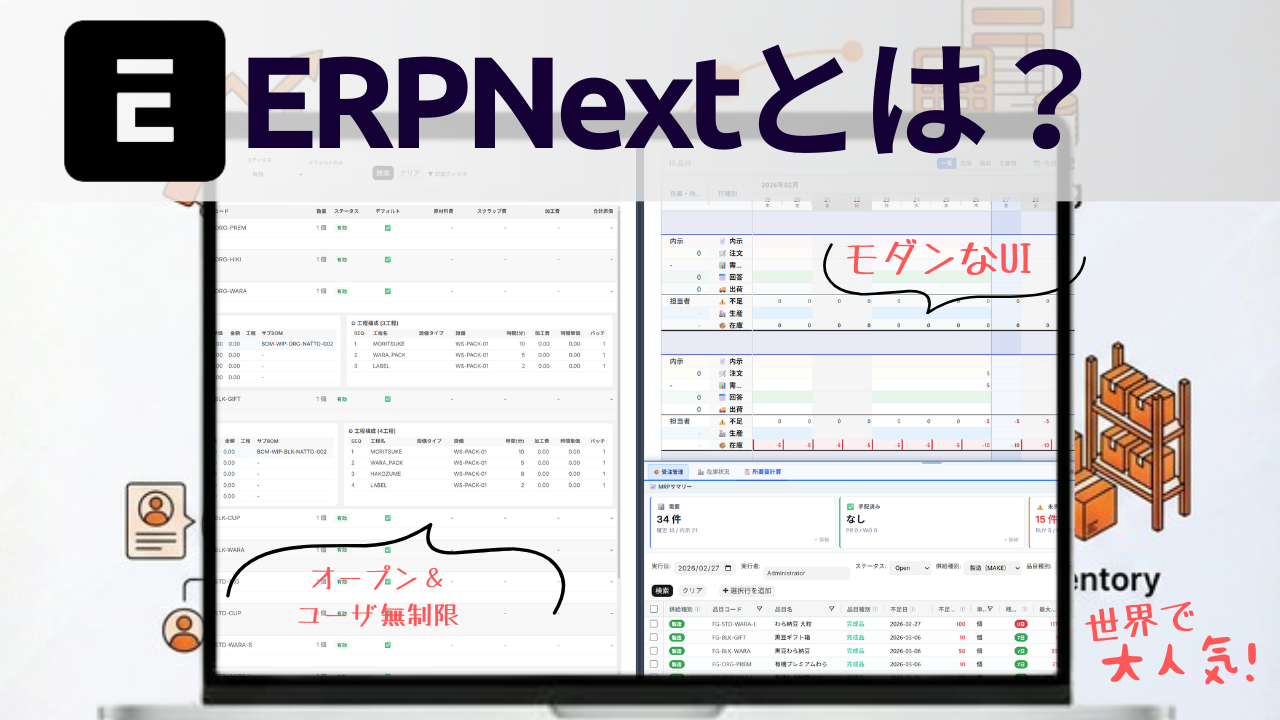
8 minUnderstand ERPNext in 3 minutes — the big picture of an open-source ERP
What ERPNext is and what business areas it covers, in three minutes. We cover module structure, how to read the official docs, and how to get started — pitched at first-time visitors.
 4 min
4 minHow to start — see the screen in 1 minute
Press the "Try now" button on this site and within 1 minute you'll get a login link to the demo. Three progressive stages — look only, evaluate after a meeting, and your own dedicated environment — let you try ERPNext as deeply as you want.
 7 min
7 minERPNext.JP Implementation Cost Guide | Own the Source as Your Asset
We reveal ERPNext.JP's cost structure: the full source code is handed over so you own the system as your asset. Includes a comparison of four major ERP systems. Contact us for pricing.