
Is GPLv3 OK for commercial use? A complete case-by-case guide
Can GPLv3-licensed software be used commercially? A clear case-by-case explanation of when source disclosure is and is not required — internal use, SaaS, API integration, and distribution. Plus the difference from AGPLv3.

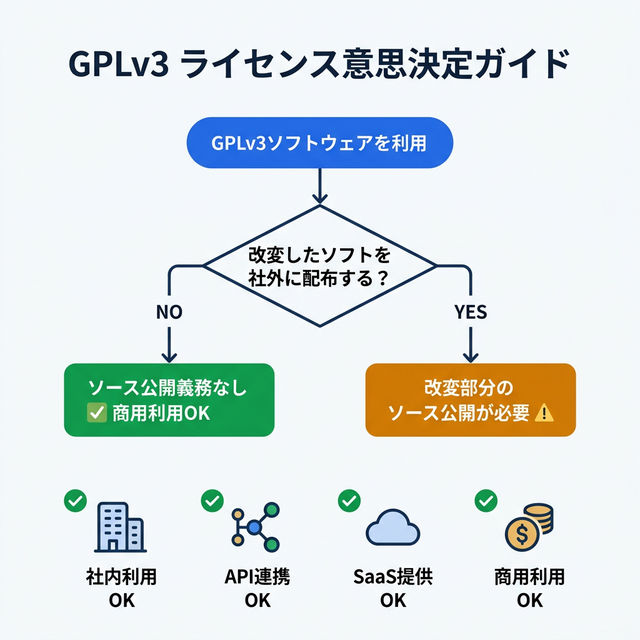
Conclusion: GPLv3 is "OK" for commercial use
GPLv3-licensed software is explicitly permitted for commercial use.
You can download it for free, run it as your business system, and generate profit with it — no problem.
The only condition is — you only need to disclose source code if you "distribute" the modified software outside your organization.
"Internal use", "API integration" and "SaaS provision" are none of them considered distribution, so there are no obligations.
Quick reference table by case
| Your usage | Source disclosure required? | Examples |
|---|---|---|
| 🏢 Use as-is internally | No ✅ | Use with any number of employees |
| 🔧 Customize and use internally | No ✅ | Form changes, custom fields, scripts |
| 🔗 Integrate with other systems via API | No ✅ | Connect to Shopify, Yayoi accounting, Kintone, etc. |
| ☁️ Provide as a SaaS-style service | No ✅ | Provide service via the browser, internal or external |
| 💰 Embed in a commercial service | No ✅ | Fine as long as the software itself is not distributed |
| 📦 Distribute modified software externally | Yes ⚠️ | Only if handing the package over to another company |
💡 What is "distribution"? It means handing the software itself (binaries or source) to a third party outside your organization. Providing services over a network or through API integration does not count as distribution.
Difference from AGPLv3 — just remember this one thing
There is only one difference between GPLv3 and the often-confused AGPLv3.
AGPLv3 treats network-based service provision (such as SaaS) as "distribution", which triggers a source disclosure obligation. GPLv3 does not treat SaaS provision as distribution. There is no obligation.
ERPNext is GPLv3
ERPNext is licensed under GPLv3. Because it is not AGPLv3, there is no source disclosure obligation whatsoever — whether you use it as SaaS or only internally. You can use it with confidence.
🔓 GPLv3 means peace of mind. Want to try ERPNext for free?
Zero license fees, unlimited users. The 14-day free trial lets you confirm it fits your operations.
Related questions
What is the difference between GPLv3 and the MIT license?
The MIT license has no disclosure obligation even when modified or distributed and is the most permissive license. GPLv3 imposes a "duty to disclose source on distribution". However, since neither internal use nor SaaS provision triggers GPLv3 obligations, the practical difference is minimal in most business contexts.
Can I combine GPLv3 software with proprietary (commercial) software?
Yes. Combining via API or data integration is fine. However, if GPLv3 code is directly embedded into a proprietary product as a single integrated system and that combined system is then distributed, GPLv3 may apply to the whole. With API-based integrations like ERPNext, you do not need to worry about this.
What if I deliver a system that includes GPLv3 software to a client?
If you hand installation media or a packaged system over to the client, that counts as distribution, so you must provide access to the source code of the GPLv3 portions. However, if the system is hosted in the cloud and the client accesses it via a browser, that is not distribution and no obligation arises.
Do I need to publish code I customized internally?
No. The source disclosure obligation under GPLv3 only triggers on "external distribution". Internal use and customization carry no restriction; you do not need to publish anything.
Summary
| Use case | Disclosure required? |
|---|---|
| Internal use and customization | No ✅ |
| API or CSV integration | No ✅ |
| Provide as SaaS service | No ✅ |
| Distribute modified software externally | Yes ⚠️ |
GPLv3 is a license that is friendly to business use.
There is no source disclosure obligation for internal use, API integration, or SaaS provision.
Adopt and use it with confidence!
Related articles
Related articles
 8 min
8 minWhy choose open-source ERP — three reasons: cost, freedom, and growth
What is an open-source ERP, and why should SMBs in particular choose one? Using ERPNext as the example, we cover cost advantages, freedom of customization, fit with AI, and even source-code purchase plans — all in plain English.
 8 min
8 minIt won't break even after updates — the strength of ERPNext's expandability design
ERPNext minimizes the risk of corruption during version upgrades through its "separation of core and custom parts" and "extension via official hooks/APIs." This article explains why you can customize it with peace of mind.
 9 min
9 minWho is Frappe, the company behind ERPNext? — Founding story and future vision
An introduction to Frappe Technologies, the developer of ERPNext: company profile, flagship services, and the founder's formative experience. Understanding their philosophy of 'democratizing ERP' will change how you evaluate the product.