
From order placement to shipment, everything is visible. Integrated ERP for the food processing industry.
This article explains the features of ERPNext.JP, which is specifically designed for the food processing industry. It supports FAX-OCR order import, barcode data entry, lot tracking, and monthly cost calculation as standard features, plus Japanese specifications.
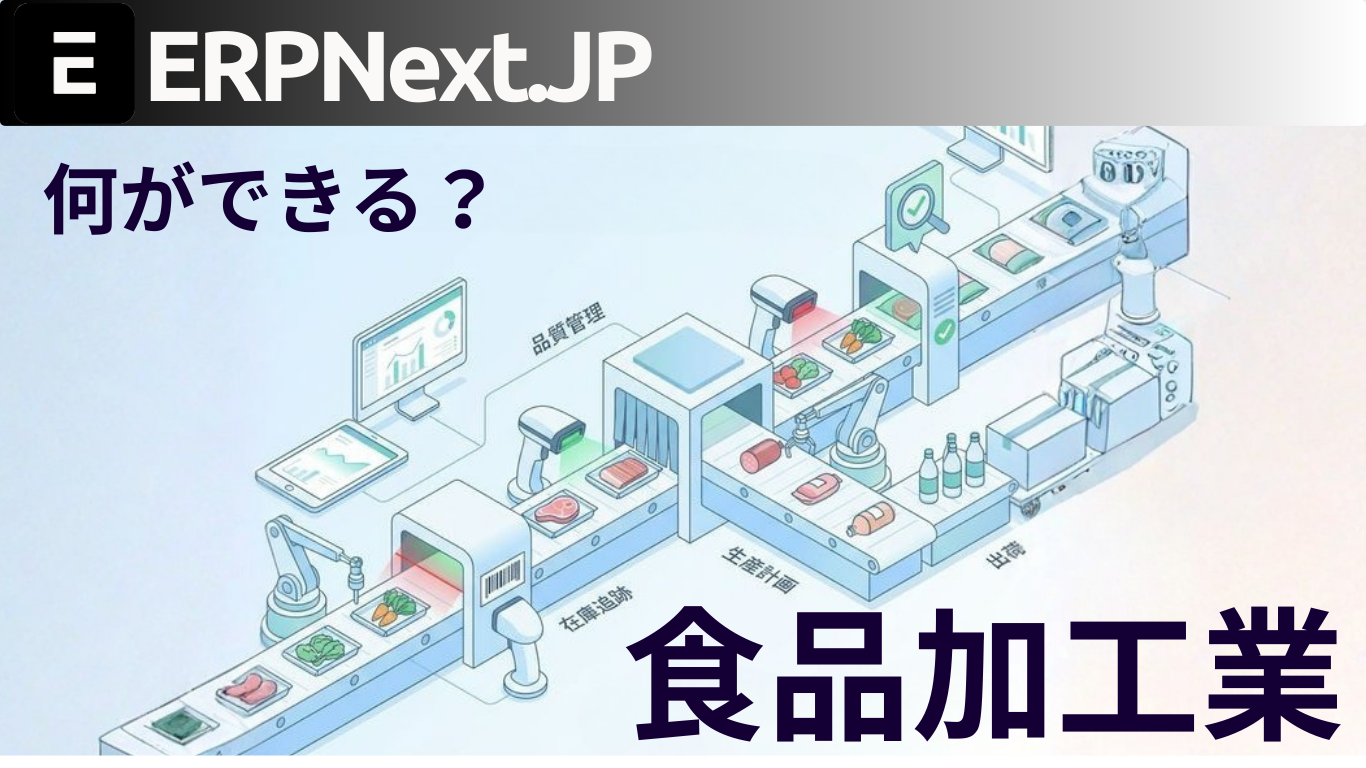
Introduction
"Do we have enough materials for today's shipment?" "How far along is that order at the factory?" —In the food processing industry, we often hear people say they cannot immediately answer these kinds of questions.
Orders are taken by fax, inventory is managed in Excel, and progress is tracked on a whiteboard. When information is scattered and disorganized, time is wasted just verifying it, and unnecessary ordering and shipping errors, as well as excess inventory, quietly erode profits.
This "invisible" problem is the biggest cause of the turmoil in the food processing industry.
Why General-Purpose ERP Systems Are Not Suitable for the Food Processing Industry
You might be thinking, "So, we just need to install an ERP system, right?" However, it's not so simple to say that a general-purpose ERP system will fit the needs of the food processing industry.
- Does not support fax orders — Fax orders from suppliers and customers require manual entry, which is time-consuming and prone to errors.
- Weak lot and expiration date management — Traceability function added later and not implemented effectively.
- UI that field workers cannot use effectively — The interface is designed for PCs and is unsuitable for gloved work in food processing plants.
- Monthly cost accounting doesn't suit the "Japanese style" — The standard cost method used in overseas ERP systems is not suitable for Japanese manufacturing.
In the end, we reverted to dual management using ERP + Excel. Many people have probably experienced the frustration of implementing a system only to find that it didn't actually make their work any easier.
🏭 5 Reasons Why ERPNext.JP is Right for the Food Processing Industry
Therefore, I would like to recommend: ERPNext.JP is.
Based on ERPNext, which has been implemented in over 30,000 companies overseas,
It is customized to suit the needs of the Japanese food processing industry.
We connect the entire process from order placement to shipment in a single line, providing a fully transparent and visible workflow as a standard feature.
📨 ① Import FAX, EDI, and EC data all at once
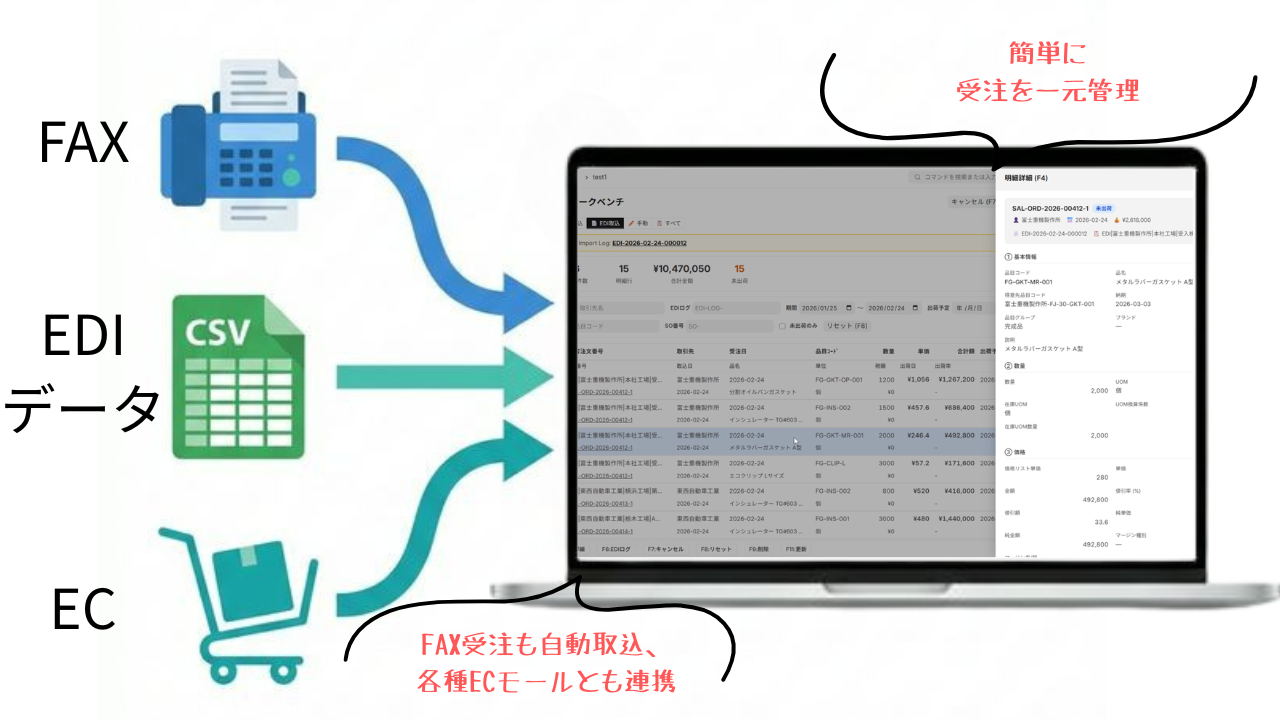
In the food processing industry, ordering methods vary from customer to customer—fax, Excel attachments via email, e-commerce marketplaces, and EDI. With ERPNext.JP, you can manage all of these in one place.
- FAXes are digitized using OCR and automatically registered as order data.
- Standard support for importing data from EDI (CSV/Excel) and e-commerce marketplaces (Rakuten, Amazon, etc.)
- Even if the entry points are different, they are integrated into a single order list within the system.
👉 You no longer need to spend hours in front of your computer entering orders.
📱 ② Manufacturing site powered by scanning
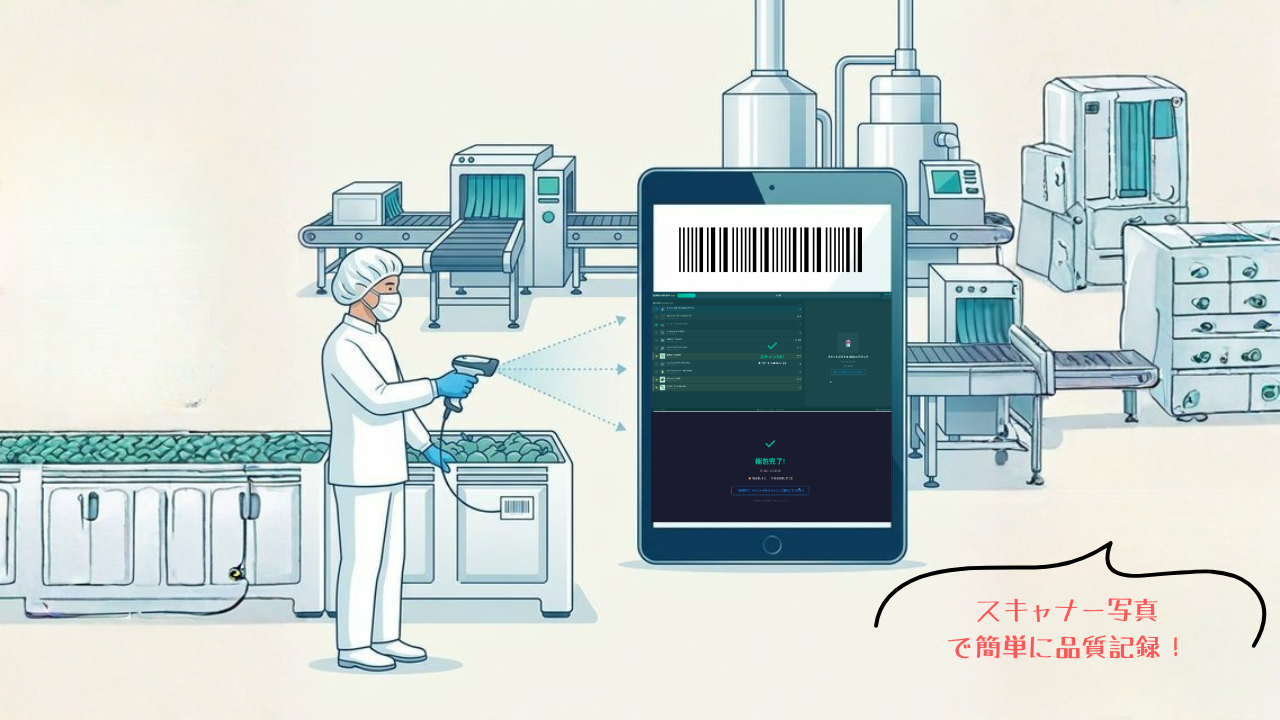
Operating a PC in a food factory is not practical. ERPNext.JP uses a barcode scan-centric approach for data entry.
- Operable while wearing gloves — Achievements are recorded simply by scanning.
- Lot and container-level traceability is automatically linked.
- It works on smartphones and tablets, so no dedicated device is required
👉 A UI that on-site workers won't feel like they "don't want to use." This is the crucial point that determines whether the system will take hold or not.
🔍 ③ Lot Tracking & Traceability
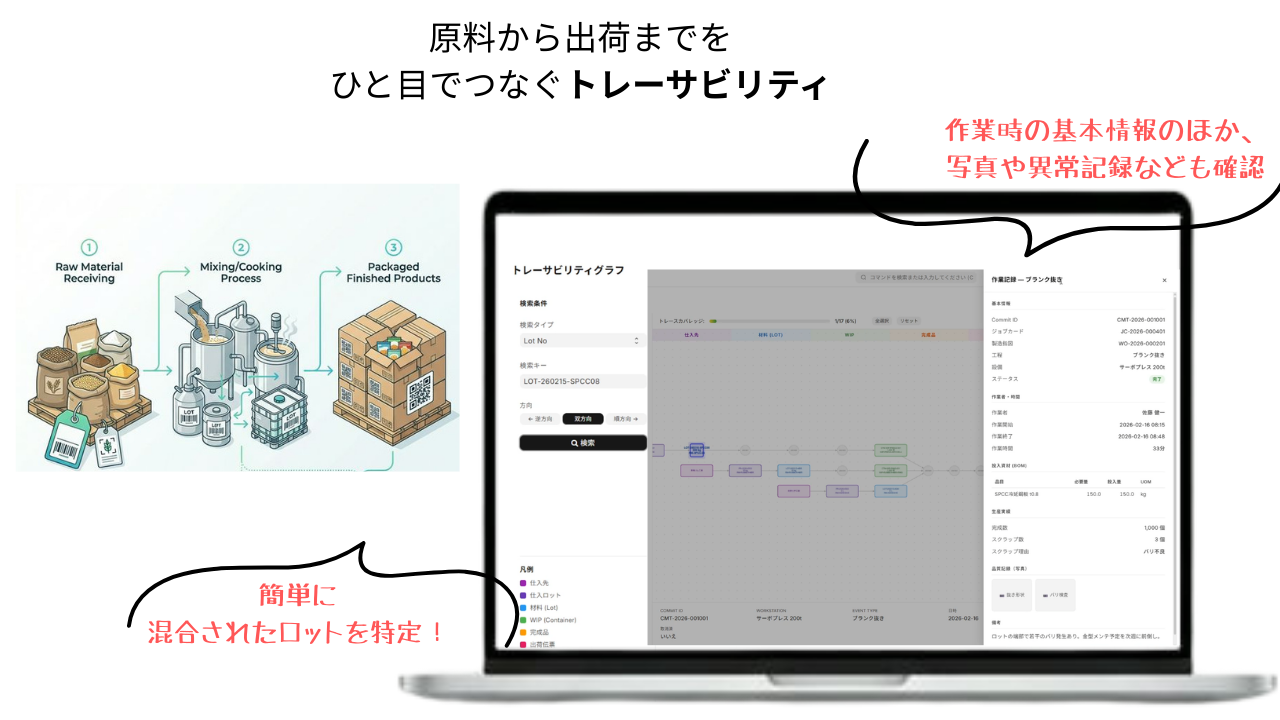
For the food processing industry, traceability is the lifeline of quality control. ERPNext.JP tracks the entire process from raw material acceptance to manufacturing and shipping, down to the container and lot level.
- In the event of a recall, the raw material lot used in this product will be immediately identified.
- Automated first-in, first-out (FIFO) management based on expiration date and receiving date.
- Supports quality documentation using photographs, allowing visual inspections to be digitally recorded.
👉 This will significantly increase the speed at which you can respond to clients and audits.
💰 ④ Monthly cost accounting (rolling calculation)
ERPNext.JP natively supports the monthly closing cost accounting method widely used in Japanese manufacturing.
- Raw material costs are calculated on a monthly rolling basis to accurately determine the product cost.
- You will be able to see in numbers which products are profitable and which are not.
- There is no need to rely solely on variance analysis against standard costs, which is common in overseas ERP systems.
👉 Instead of just thinking, "I have a feeling that the profit margin has gone down somehow," Based on evidence This allows for business decisions.
🎯 ⑤ Cost Visualization — Own the Source Outright, Unlimited Accounts
ERPNext.JP hands over the full source code as part of implementation — own the system as your asset. There are no additional fees based on the number of users.
- Part-time and partner company staff can also freely be issued accounts.
- Verify with a fixed-scope PoC → own the full source → optional maintenance subscription (contact us for pricing)
- If you'd rather have us run the servers, an optional managed cloud plan is available
- Try it now with a 14-day free trial
The full source is handed over — all features, unlimited users, your own asset. If you want us to run the servers too, an optional managed cloud plan is available. Contact us for pricing.
summary
ERP Next.JP is
Required of the food processing industry "FAX-OCR order processing × barcode data entry × lot tracking × monthly cost calculation" are covered as standard features, providing seamless "visualization" from order placement to shipment.
Furthermore, while leveraging the flexibility of OSS, it is optimized for Japanese business practices (10%/8% reduced consumption tax, invoices compliant with the invoice system, and payment reconciliation via Zengin CSV). We offer an ERP system that is truly usable by the field staff, at a price point that makes it easy to implement even for food processing companies with 30 to 100 employees.
ERPNext.JP offers more than just production management software. This is an integrated ERP platform for the food processing industry that centralizes "order taking, manufacturing, inventory, quality control, and accounting."
👉 First, try it out with the 14-day free trial. We encourage you to experience firsthand how well it fits your company's operations. If it doesn't suit you, you can quit anytime.
Related articles
 7 min
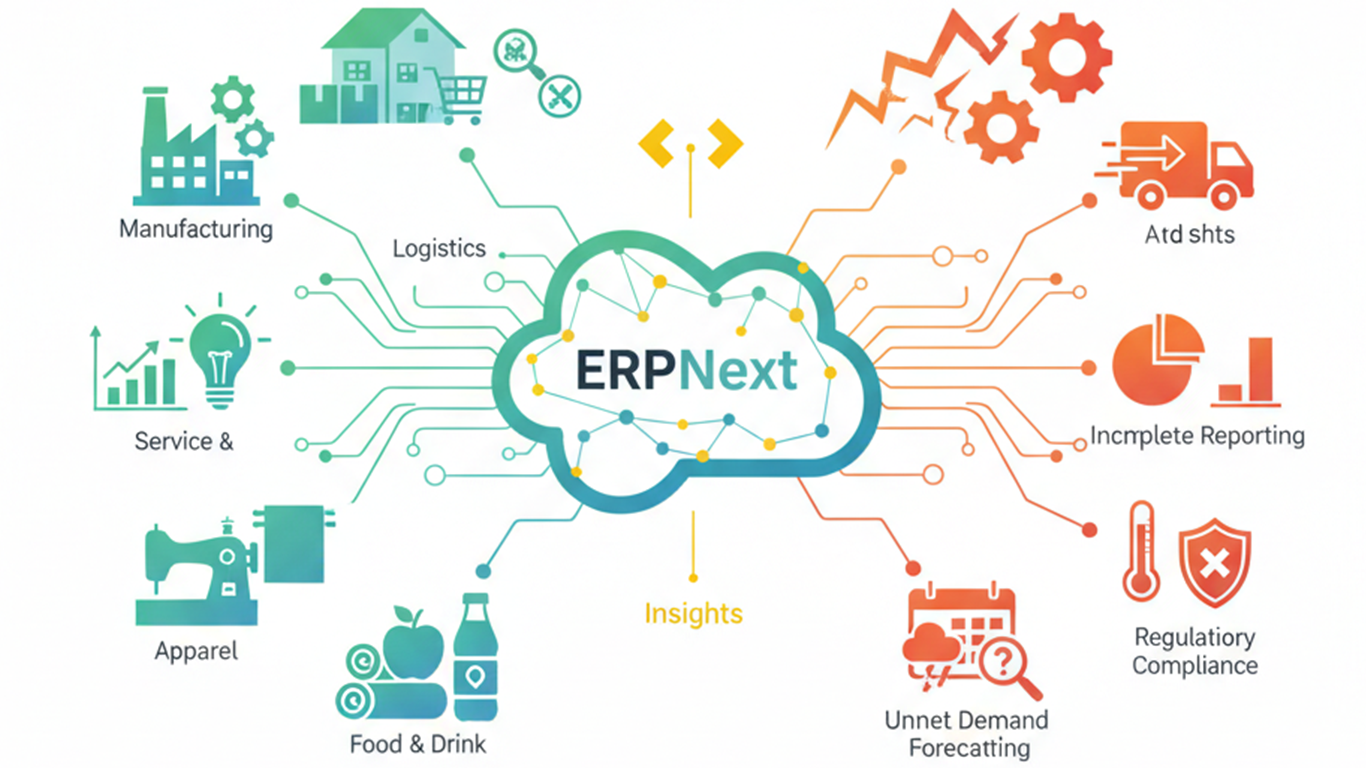
7 minWhy ERPNext is effective for food processing and parts manufacturing companies — Industry-specific fit analysis
This article explains why ERPNext is particularly strong in the food processing industry (e-commerce, fax, and direct sales) and the automotive parts manufacturing industry, using a table that aligns implemented features with industry-specific challenges. Please use this as a basis for your implementation decision.
 8 min
8 minBreaking the Limitations of Excel Inventory Management — Eliminating the "Invisibility" of Inventory with ERPNext
Inventory discrepancies, taking a whole day to complete inventory counts... This article explains how ERPNext.JP solves these problems, from its overall functionality to the benefits of implementation.
 8 min
8 minA demand forecasting calendar to solve the problems of "overproduction" and "shortage" in make-to-stock production.
This explains the mechanism of the demand forecasting calendar that runs on ERPNext. It automatically calculates the optimal production increase quantity for e-commerce sales, reducing waste and lost sales opportunities.