
Why ERPNext is effective for food processing and parts manufacturing companies — Industry-specific fit analysis
This article explains why ERPNext is particularly strong in the food processing industry (e-commerce, fax, and direct sales) and the automotive parts manufacturing industry, using a table that aligns implemented features with industry-specific challenges. Please use this as a basis for your implementation decision.
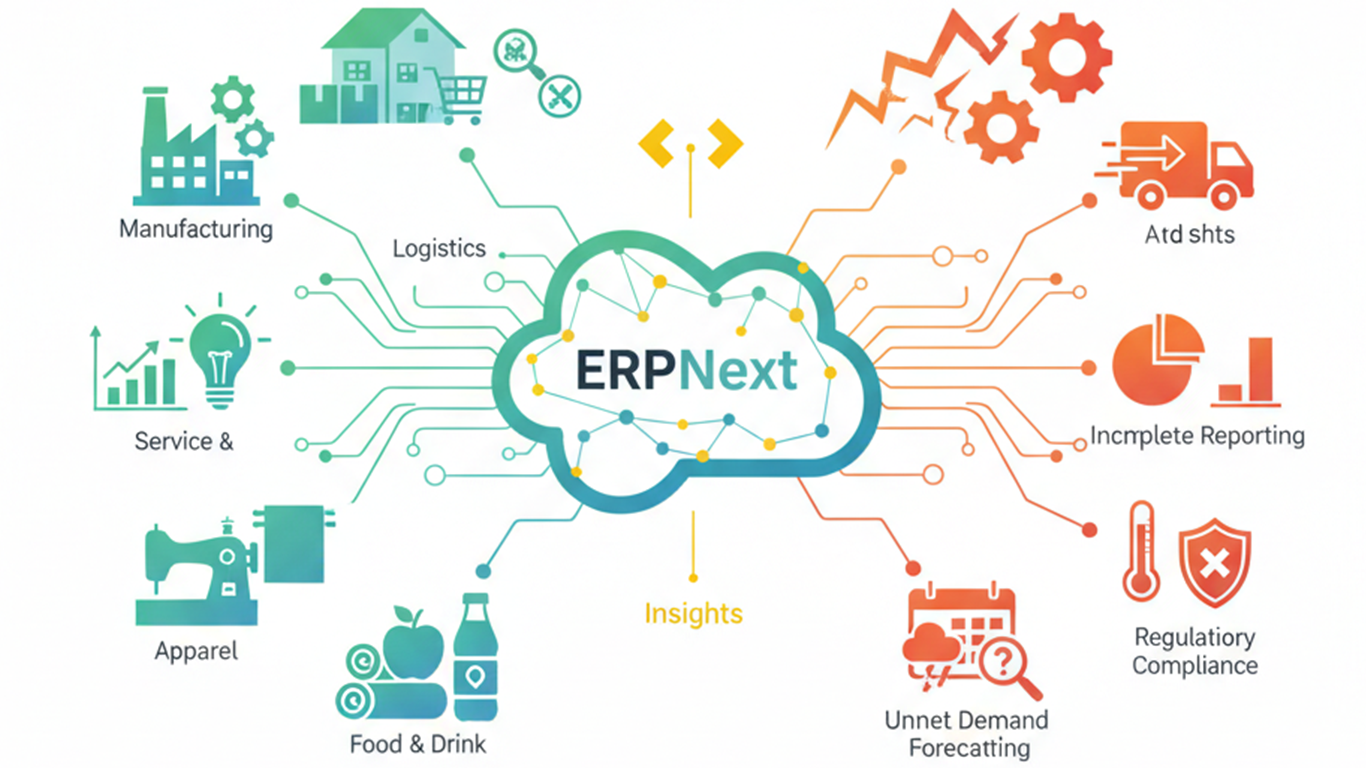
Introduction — "Is this really applicable to our industry?"
When considering implementing an ERP system, the biggest concern is probably whether it's suitable for our company's industry.
ERPNext is an open-source ERP system used by over 30,000 companies worldwide. However, it's difficult to determine "which industry it's suitable for" simply by looking at a list of features.
Therefore, in this article, we at ERPNext.JP will share our experience in actual custom development, Food processing industry and Small and medium-sized manufacturers of automotive parts and other products Focusing on these two targets, we will specifically explain where ERPNext is effective and what problems it can solve.
🍱 Food Processing Industry × ERPNext.JP — On-site Challenges and Solutions

The food processing industry is an industry with many tasks that cannot be fully covered by general-purpose ERP systems, such as the large number of order channels (fax, e-commerce, direct sales), the requirement for traceability at the lot level, and the management of expiration dates.
ERPNext.JP addresses all of these challenges with its pre-implemented features.
| Challenges in the Food Processing Industry | ERPNext.JP's Response |
|---|---|
| We receive many orders via fax, which makes manual data entry time-consuming. | Automatic Fax-OCR Import — Convert fax to PDF → AI reads the data → Automatically registers it as order data. |
| Order management for e-commerce (Rakuten, Amazon, etc.) is handled by a separate system | EC Mall API Integration — Automatically import order data and centrally manage inventory in real time |
| Lot and expiration date tracking relies on Excel | Container and lot-level traceability — Tracking the entire process from raw material receipt to manufacturing to shipment |
| Field staff cannot use PCs | Barcode scan-centric UI — Use a smartphone while wearing gloves. No keyboard required. |
| Monthly costs are only roughly known | Monthly Rollover Cost Calculation — Automatically determine accurate costs by product and lot every month |
| Unable to determine the scope of impact during a recall | Two-way tracing — Identify both upstream (raw materials → finished product) and downstream (finished product → destination) in seconds |
| Quality records are paper-based | Quality records with photos — Take a photo with your smartphone and it will be automatically linked to the lot and container |
💡 All of these are included as standard features with no additional development costs.
Post-implementation image in the food processing industry
📠 朝のFAX → OCRが自動読取 → 受注データとしてERPに登録
🛒 ECの注文  → APIで自動取込 → 倉庫の在庫がリアルタイム更新
📋 生産計画   → MRPが原材料不足を自動検出 → 購買依頼を自動作成
📱 製造現場   → バーコード2スキャンで実績入力 → ロット追跡が自動記録
📦 出荷     → スキャンでピッキング照合 → 取り間違いゼロ
💴 月末     → 請求書ワンクリック発行 → 転がし原価計算を自動実行
🔩 Automotive Parts & Small and Medium-Sized Manufacturing Companies × ERPNext.JP

Small and medium-sized manufacturers, including those producing automotive parts, often face obstacles due to unique business practices such as different EDI formats for each customer, managing differences between preliminary and final orders, and handling customer part numbers.
ERPNext.JP already addresses these issues with its implemented features.
| Challenges faced by small and medium-sized manufacturing companies | ERPNext.JP's solution |
|---|---|
| Different EDI formats for each customer | Flexible EDI column mapping — Import CSV/Excel files directly, absorbing format differences |
| Managing the difference between preliminary and final orders relies on Excel | Automatic tracking of change history — Automatically detects and fully records increases and decreases in quantities compared to the previous import |
| Managing customer part numbers and our own part numbers is cumbersome | Customer Part Number Mapping — Automatically convert part numbers for each customer |
| Multi-stage BOM development is complex | Up to 5 levels of multi-stage BOM development — Automated development from semi-finished products to intermediate products to raw materials |
| Production planning is dependent on individual employees | Automated MRP calculation — Requirements calculation considering safety stock and lead time → Batch generation of manufacturing orders and purchase requisitions |
| Equipment schedule is not visible | Gantt chart — Visualize equipment-specific schedules and adjust with drag and drop |
| Kanban shipping management is left to the field staff | Kanban scan → Pick → Automatic sorting → Batch shipping |
| Quality control does not meet ISO standards | Inspection standards for each process — Digital management of inspection records for receiving, assembly, and shipping |
Post-implementation image at an automotive parts manufacturer
🔗 得意先EDI  → 列マッピングで自動取込 → 内示/確定を一元管理
📊 数量変更   → 前回との差分を自動検出 → 変更ログを完全記録
🏭 生産計画   → MRPが多段BOM展開 → 部品の所要量を自動算出
📱 製造現場   → バーコードスキャンで実績入力 → ロット追跡が自動記録
📦 かんばん出荷 → スキャン → SOごとに自動仕分け → 一括出荷
📈 設備管理   → ガントチャートで可視化 → ドラッグ&ドロップで調整
📊 Industry-Specific Fit Quick Reference Chart
This document summarizes the industries currently covered by ERPNext.JP and the general suitability of standard ERPNext.
| Industry | Fit | Strengths of ERPNext.JP | Points to Note |
|---|---|---|---|
| Food processing industry (EC, FAX, Direct Sales) | ⭐⭐⭐ | FAX-OCR, lot tracking, expiration date management, cost calculation, and barcode data entry are all implemented | HACCP certification forms are handled on a case-by-case basis |
| Automotive Parts (Tier-2 to 3) | ⭐⭐⭐ | All features implemented: flexible EDI import, preliminary/confirmed difference management, customer part number support, Kanban shipping, and equipment Gantt charts | IATF 16949 certification requirements are handled on a case-by-case basis |
| General Small and Medium-Sized Manufacturing Companies | ⭐⭐⭐ | Multi-stage BOM, MRP, Traceability, Monthly Cost Accounting | — |
| Distribution & Wholesale | ⭐⭐☆ | Inventory management, multiple warehouses, barcode management, integrated order processing | Large-scale WMS available upon request |
| Chemistry/Pharmaceuticals | ⭐☆☆ | Inventory and purchasing available | Process control, formulation management, and GMP compliance require extensive customization |
💡 Key Point: In general assessments prior to 2025, ERPNext was considered weak in the "food processing" and "automotive parts" sectors. ERPNext.JP focuses on these two industries and has developed customized solutions to address their weaknesses, which have been addressed by incorporating them into standard features.
🔑 Three key differences between ERPNext.JP and other ERP systems
① Don't choose a "gateway" — Integrating multi-channel order taking
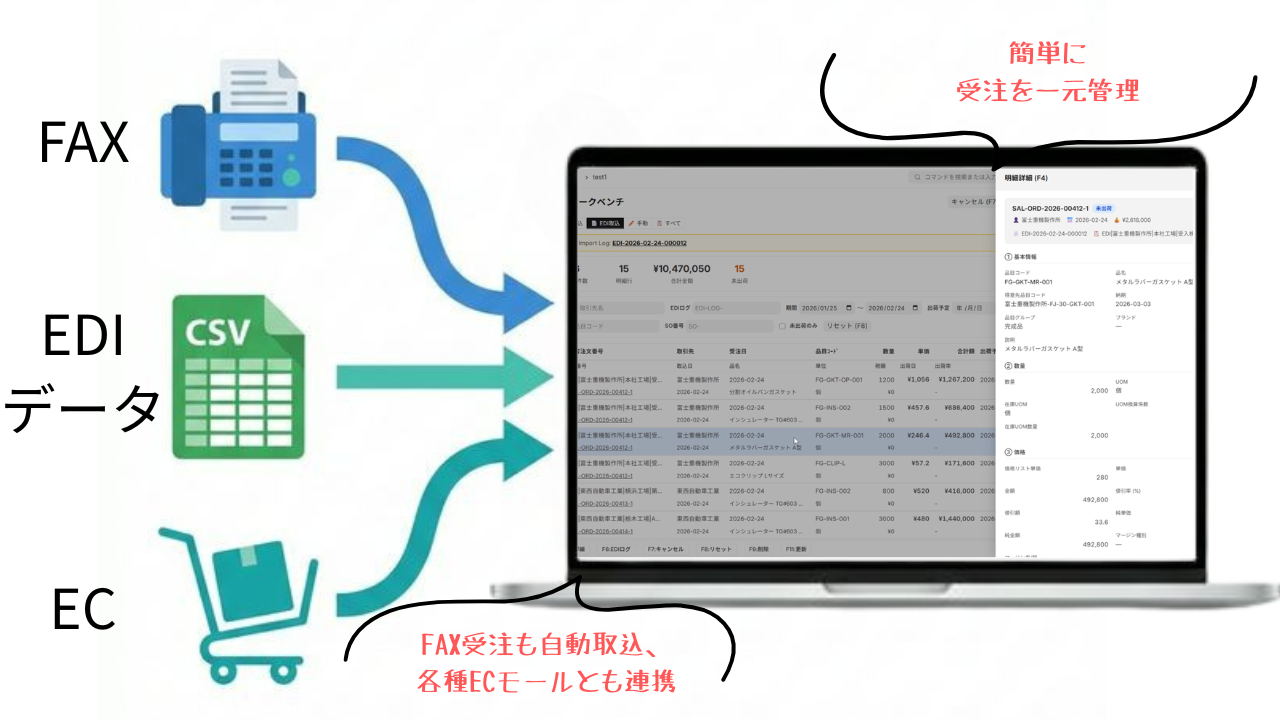
Fax, EDI, e-commerce, manual entry. Even if the order entry points are different, within the ERP system, it becomes a single line. While other cloud-based ERP systems often offer "EC integration as an option" and "FAX support not being available," ERPNext.JP includes all of these features as standard.
② "On-site" operation is possible — Barcode-based operation
Neither food processing plants nor parts factories are practical places to use keyboards. ERPNext.JP is designed so that performance data entry can be completed with just two barcode scans. It works on smartphones and tablets; no dedicated device is required.
③ Don't stop at "money" — own the source, unlimited users
The full source code is handed over — own all features and unlimited users for order processing, inventory, production, shipping, invoicing, and cost accounting as your asset (verify with a fixed-scope PoC first; an optional maintenance subscription is available). If you'd rather have us run the servers, an optional managed cloud plan is available (contact us for pricing). Either way there is no per-user billing and no minimum contract period, and accounts can be provided to part-time staff and partner company employees.
Answers to Common Concerns
| Anxiety | Answer |
|---|---|
| "I've never used an ERP system before." | Intuitive operation with an Excel-like UI. On-site operations are completed solely by barcode scanning. |
| "Will I be locked into a vendor?" | GPLv3 open source. Source code is permanently public. Free to switch to other vendors in the future. |
| "We have foreign staff" | One-click switching to over 70 languages |
| "I want to try it first before deciding." | 14-day free trial available. No automatic billing. |
Summary — You can tell if it's a good fit or not by touching it.
ERPNext is not a panacea. However, for two industries, food processing (EC, fax, direct sales) and small and medium-sized parts manufacturing (EDI, Kanban), ERPNext.JP has thoroughly analyzed the on-site challenges and solved them as implemented functions.
- ✅ FAX-OCR, EDI, EC — Integrating multi-channel order processing into a single system
- ✅ Barcode scanning — Operable even while wearing gloves. A system used on-site.
- ✅ Lot tracking and traceability — Identify in seconds, even during recalls.
- ✅ Monthly cost accounting — Visualizing profitable and unprofitable products with numbers
- ✅ EDI differential tracking and Kanban shipping — Standard compliance with automotive industry business practices
- ✅ Full source handed over — own all assets; unlimited users, no minimum contract period (contact us for pricing).
👉 Try it out with a 14-day free trial by entering your company's business data. You can tell whether it's a good fit or not by touching it.
Related articles
 5 min
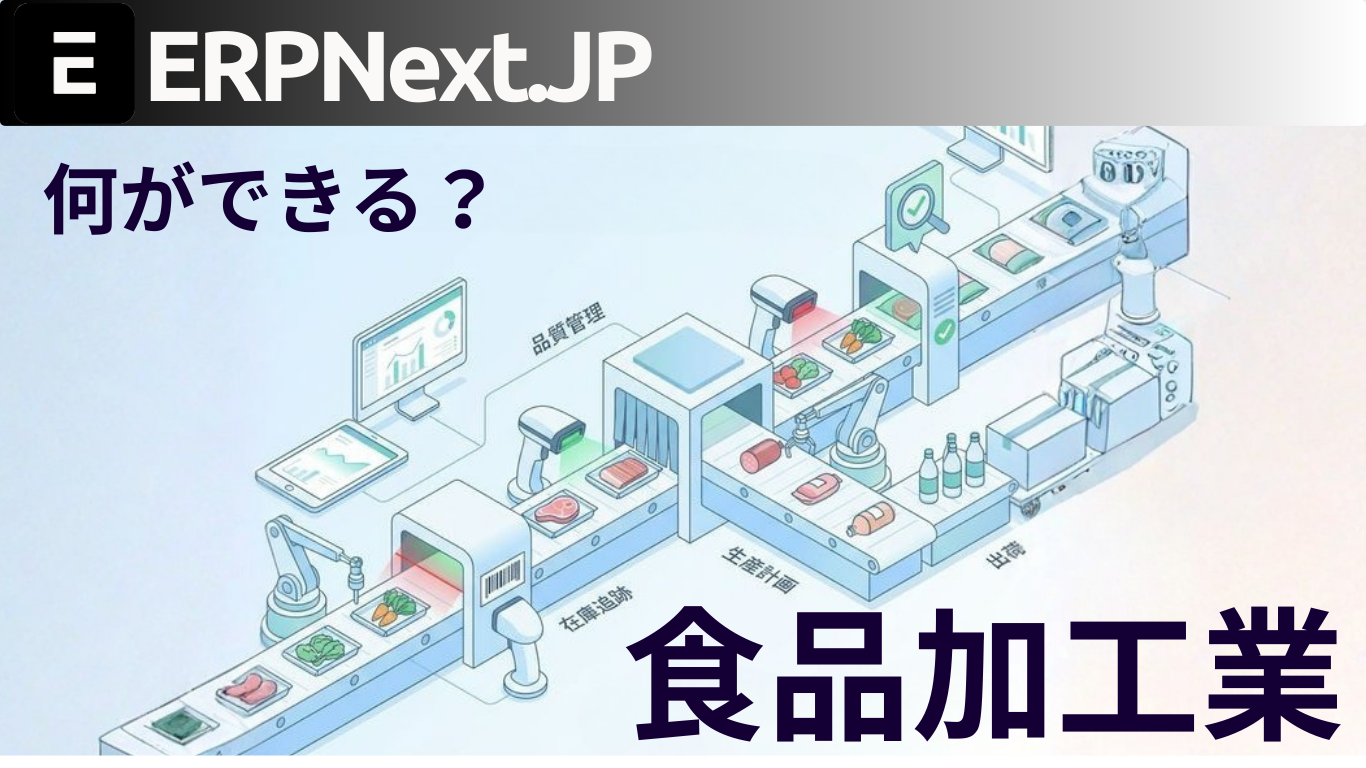
5 minFrom order placement to shipment, everything is visible. Integrated ERP for the food processing industry.
This article explains the features of ERPNext.JP, which is specifically designed for the food processing industry. It supports FAX-OCR order import, barcode data entry, lot tracking, and monthly cost calculation as standard features, plus Japanese specifications.
 10 min
Trading companies' ERP utilization strategies — centralized management of multi-location warehouses, VIP pricing, and foreign currency transactions.
This article explains the convenient features of ERPNext.JP, which is specifically designed for trading companies. It supports multi-site warehouse management, VIP customer pricing, foreign currency transactions, and credit management with standard features plus Japanese specifications.
 8 min
8 minA demand forecasting calendar to solve the problems of "overproduction" and "shortage" in make-to-stock production.
This explains the mechanism of the demand forecasting calendar that runs on ERPNext. It automatically calculates the optimal production increase quantity for e-commerce sales, reducing waste and lost sales opportunities.