
Breaking the Limitations of Excel Inventory Management — Eliminating the "Invisibility" of Inventory with ERPNext
Inventory discrepancies, taking a whole day to complete inventory counts... This article explains how ERPNext.JP solves these problems, from its overall functionality to the benefits of implementation.

Introduction
Modern inventory management is becoming increasingly complex as sales channels diversify. Supporting multiple distribution channels such as e-commerce sites, POS systems, and wholesale sales, From product turnover and expiration dates to lot and variation management, The burden on those on the ground is only increasing.
on the other hand,
- High staff turnover
- The team includes overseas staff who are not fluent in Japanese.
Combined with these staffing challenges, traditional, person-dependent Excel management proved insufficient. This leads to limitations such as "inventory discrepancies," "inventory counting taking too long," and "discrepancies between the figures from the field and accounting."
That's why I'd like to introduce ERPNext.JP.

ERPNext is an open-source ERP system that originated in India, a country of diversity, and is now used worldwide, including in Germany and the United States.
- Excel-like interface
- Simple and intuitive operation
**💡 Anyone can use it right away This ERP system is designed with a focus on exclamation points!
Furthermore, the user interface can be switched to 70 languages worldwide with a single click. It can be used with confidence even in workplaces with a mix of multinational staff, including those speaking Vietnamese, Chinese, English, and Indonesian.
And ERPNext.JP is
It's available at a price accessible to SMEs (contact us for pricing).
So then— "What can you do with inventory management in ERPNext.JP?" Let's look at this in more detail.
What is ERPNext.JP?
ERPNext.JP offers the ERP Next platform, which has been implemented in over 30,000 companies worldwide for over 15 years since its inception.
This is an integrated business system customized for the Japanese market.
Sales, accounting, human resources, manufacturing, and even inventory management,
✅ General ERP and Equivalent or superior features are included as standard. death,
✅ No extra charge
It is available here.
To give you just one example, I'll introduce it by dividing it into three main areas:
### 🔷 Core business
- Manage the entire process from quotation to payment in one seamless manner (automate the sales process).
- Real-time inventory tracking (by warehouse, location, and barcode compatible)
- Visualizing the manufacturing site (centralized management of BOM, labor units, and progress)
- Record and analyze sales activities (prospects, follow-up history, pipeline management)
- Flexible workflow (automatic linkage of approval routes, accounting processes, and inventory movements)
- Streamline accounting processes (automatic journal entries, consumption tax handling, financial statement output)
- Integrated management of personnel and payroll (attendance, payroll calculation, personnel ledger)
- Project progress management (visualizing tasks, man-hours, and costs)
- Instantly visualize key performance indicators (displayed in real time on the dashboard)
### 🔶 Items that are well-received on-site
- Operable like Excel (supports inline editing and multi-row display)
- Instant input via mobile or barcode (on-site processing of incoming/outgoing items and approvals)
- Switchable to over 70 languages (foreign staff can become productive immediately)
- Access control that shows only necessary information (controllable by department, warehouse, and document level)
- Assign tasks and share progress (assignee, status, and comments all on one screen)
- Automatic alert notifications (advance warnings about delivery delays and stock shortages)
- Automatic purchasing by simply setting the reorder point (preventing the risk of stockouts).
- Integrated management of the entire group (operating multiple companies and locations in parallel)
### 🔷 Non-functional features that can be used with peace of mind
- Expandable as needed ( Add functionality with a custom app; no device modification required. )
- Records all operation history (allows tracking who did what and when)
- Easy external integration (API and Webhook supported as standard)
- Easy backup and restore (handled using DB snapshots and benchmark commands)
- Suitable for small to large scale (scalable from a few people to hundreds of people)
What's amazing is that it comes standard with features that address even the smallest details!
Features of ERPNext.JP's Inventory Management System
So, what can you do with inventory management in ERPNext.JP? Here are three representative features.
🔹 Multiple sales channels and real-time inventory management
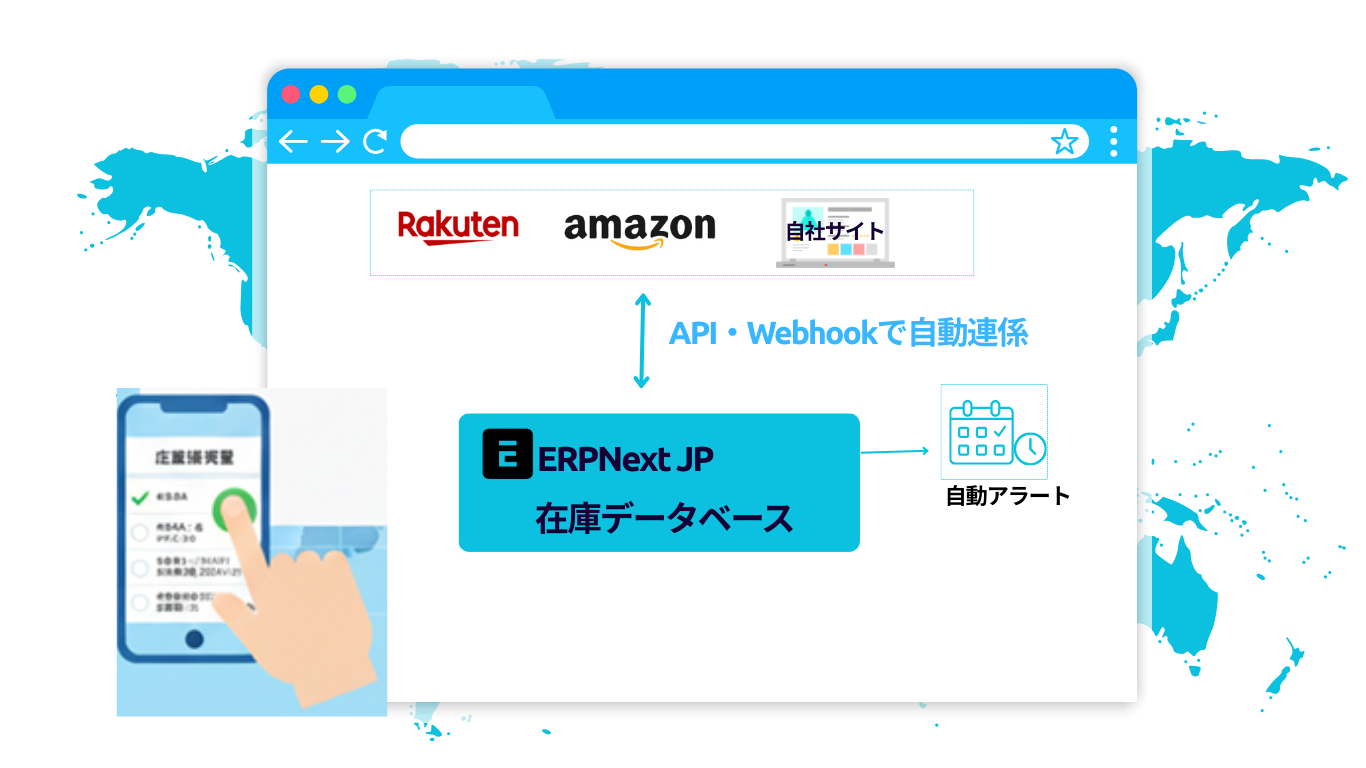
In today's world, it's commonplace to use multiple channels such as e-commerce sites like Rakuten and Amazon, direct sales, and wholesale. While managing a single channel can be done with Excel, inventory management quickly becomes complex when dealing with multiple channels simultaneously.
With ERP Next.JP,
✅ API and Webhook are included as standard features, allowing for seamless and automatic synchronization of inventory levels with external e-commerce sites.
💡 You can synchronize inventory across multiple sales channels in real time.
moreover
✅ Products with the same product number but different colors/sizes, as well as products with expiration dates can be managed as standard.
💡 When combined with automatic alerts, you can also automatically adjust the prices of products nearing their expiration date.
"It sold, but we're out of stock," "We stocked it, but the update is delayed," "Before we knew it, it was past its expiration date"— This will prevent such confusion from occurring.
🔹 Warehouse/Location/Shelf-level / Efficiency improvements for picking operations

📚 Flexible inventory management granularity
The level of inventory management required varies depending on the company and the product.
ERP Next.JP
✅ Warehouse/Location/Shelf Unit In addition,
✅ Same product Different sizes and colors Variations and Expiry date
These elements can be flexibly managed. Of course, it can also handle management at a broader level.
🚚 Efficiency improvements for outbound shipping operations
Furthermore, improving the efficiency of outbound shipping operations is a point that companies adopting the system particularly value.
Output a picking list automatically generated from sales information.
By scanning the QR/barcode (shelf tag, lot number, serial number, etc.) attached to the product, 💡 It can automate everything from verifying the match between the planned shipment and the actual shipment, to entering shipment information and printing delivery slips.
The picking list also includes the location of the stock, allowing for quick and accurate picking. Barcode verification prevents misdeliveries, and combined with the document output function, significantly streamlines on-site operations. I will.
🔹 Reorder point management aiming for zero stockouts
Stock shortages lead to lost sales opportunities, while excess inventory puts a strain on cash flow. Leaving this balance entirely up to those on the ground has its limitations.
ERPNext.JP automatically creates a purchase requisition when inventory falls below a certain level. Furthermore, by utilizing BOM (Bill of Materials) for requirements calculation, it is possible to perform ordering simulations based on the projected number of orders. the result,
💡 This system prevents material shortages, avoids stockouts, and enables efficient operations with minimal inventory.
Thus, ERPNext.JP's inventory management is,
- Seamless integration with multiple channels (support for variations and expiration dates)
- Visualization of inventory across warehouses, locations, and facilities.
- Preventing stockouts through reorder point management and BOM requirements calculation.
These No additional fees - only 30,000 yen per month It is available.
Actual Cases
Here are four examples related to inventory management from ERPNext's official case studies.
🛍️ Retail Industry ― Elevate Luxury Retail Operations
Luxury retailer Elevate faced significant challenges in managing inventory across its physical and online stores.
- Integration of POS and EC:
The sales and inventory modules of ERPNext are integrated, allowing online orders and in-store sales to be instantly reflected in inventory.
→ Resolving inventory mismatches across channels . - Variation Management:
Organize product variations such as color and size using the item variant function.
→ Improved inventory accuracy. Reduced duplicate entries and mismanagement. . - Returns and Logistics Integration:
By centralizing return processing and shipping management, we reduce rework in warehouse operations and sales management.
✨ Result: Inventory errors decreased, and we were able to provide customers with accurate delivery date information.
🛒 Retail Industry ― Chewy's ERP Next Success Story
US retail Chewy, Inc. Due to rapid growth, the company was experiencing inventory inconsistencies and shipping delays.
- Real-time synchronization of inventory and orders:
All online orders, in-store sales, and wholesale operations are linked to inventory in real time. Prevents shipping delays and duplicate orders. . - Integration of CRM and purchase data:
Integrate customer data and purchase history into CRM
→ Optimize replenishment and ordering based on demand forecasts. . - Financial Integration:
Sales and purchase data are instantly reflected in accounting, improving the speed of monthly closing.
✨ Results: Shipping accuracy and speed improved, leading to increased customer satisfaction.
🏭 Manufacturing industry - Shimnit India Private Limited
Indian manufacturing giant Shimnit India Insufficient material management and inventory accuracy across multiple locations were reducing production efficiency.
- Integration of manufacturing and inventory:
By directly linking the Bill of Materials (BOM) and manufacturing orders to the inventory system, parts shortages can be detected in advance. - Inventory Visualization:
Real-time access to inventory balances for each warehouse and location.
→ Linked with reorder point management. Prevents over-ordering. . - Purchasing and Accounting Integration:
Integrate purchasing and accounting to instantly visualize costs.
→ Cost management accuracy improved .
✨ Results: Line stoppages due to material shortages decreased, and lead times were shortened.
🧱 Building materials industry - Supreme Tile
North American building materials suppliers Supreme Tile Paper-based and email-based processes were leading to reliance on individual employees and errors.
- Automatic synchronization of orders and inventory:
Import orders from customer portals and e-commerce into ERPNext.
→ Inventory and instant synchronization . - Reorder point management and supplier coordination:
When inventory falls below a threshold, a purchase requisition is automatically created, streamlining supplier coordination. - Business Process Automation:
Automate invoice processing, inventory records, and shipping slips with ERPNext.
→ Reduced manual labor by 80% .
✨ Results: Lead handling time was reduced by 30%, and inventory turnover and delivery accuracy improved.
summary
As we have seen so far,
- There is also the problem of inventory being fragmented across multiple channels.
- The complex management at the warehouse/location level,
- Losses due to stock shortages or excess inventory,
Moreover, 30,000 yen per month At such an affordable price.
We at MyHatch provide support from the implementation to the operation of ERPNext. We provide support to ensure that the system can be used in a way that suits the specific needs of the Japanese workplace.
- "I'd like to try it out on a small scale first."
- "I'm worried whether we can really manage this ourselves."
If that sounds like you, please feel free to contact us for a consultation. ERPNext.JP will be the foundation that supports your company's growth.
Related articles
 5 min
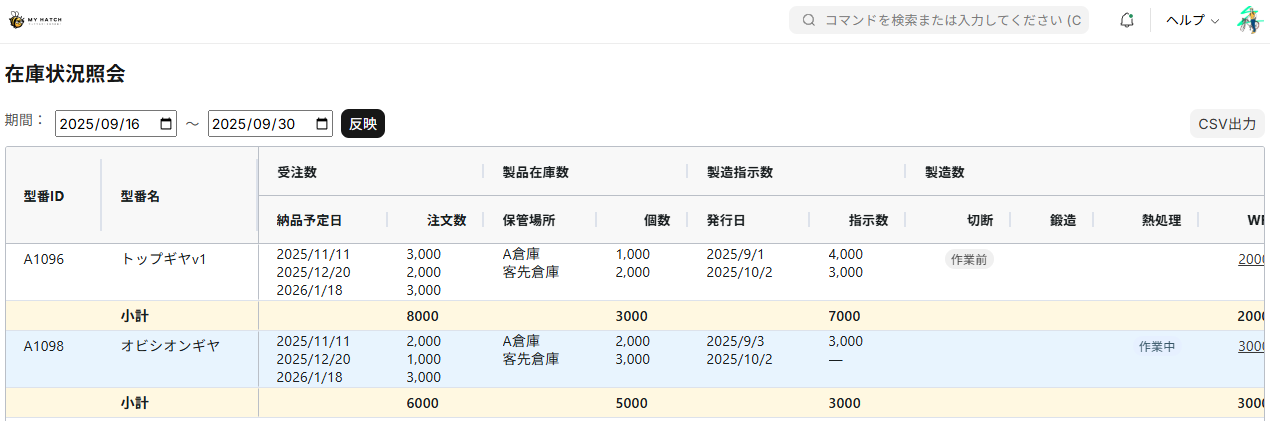
5 minView inventory in an Excel-like format — ERPNext.JP's inventory status inquiry screen
Introducing an inventory inquiry screen that's intuitive even for those familiar with Excel. The item x warehouse matrix display visualizes inventory status in real time.
 5 min
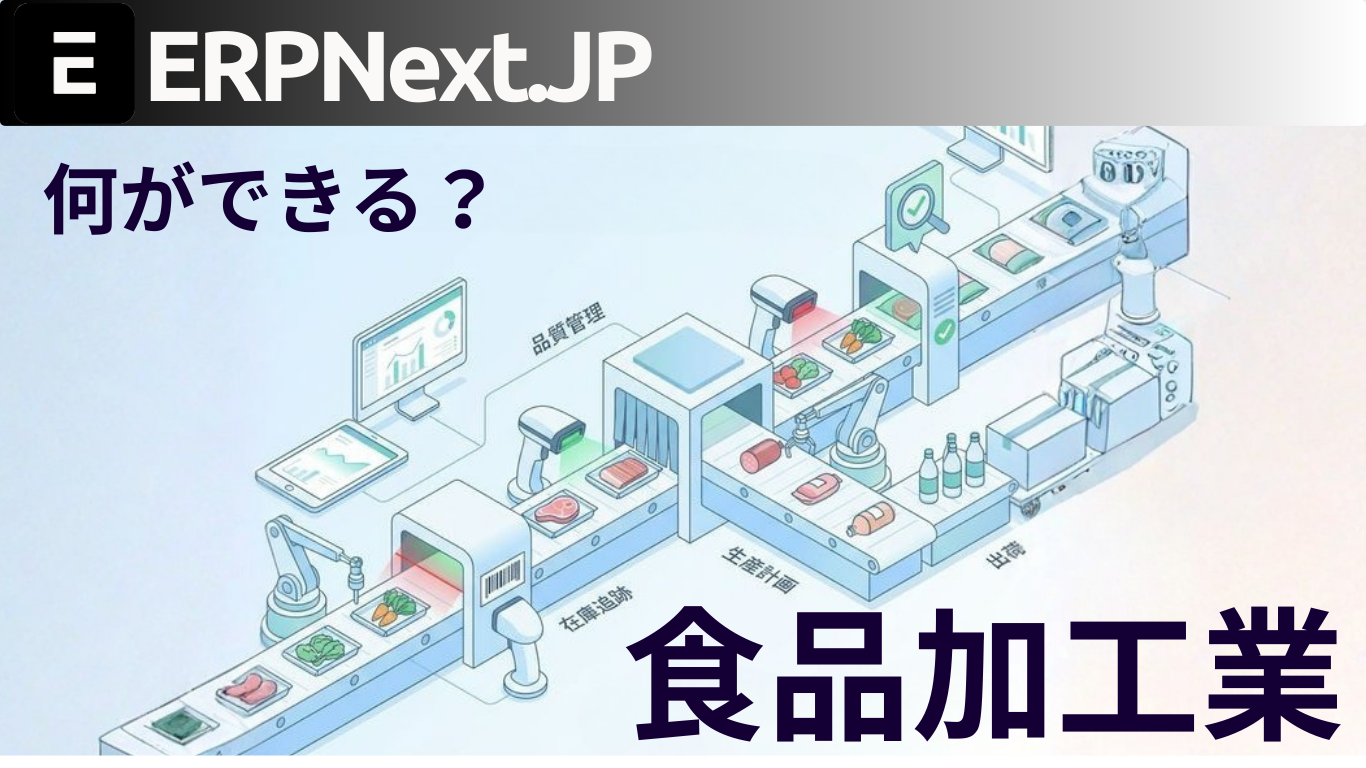
5 minFrom order placement to shipment, everything is visible. Integrated ERP for the food processing industry.
This article explains the features of ERPNext.JP, which is specifically designed for the food processing industry. It supports FAX-OCR order import, barcode data entry, lot tracking, and monthly cost calculation as standard features, plus Japanese specifications.
 8 min
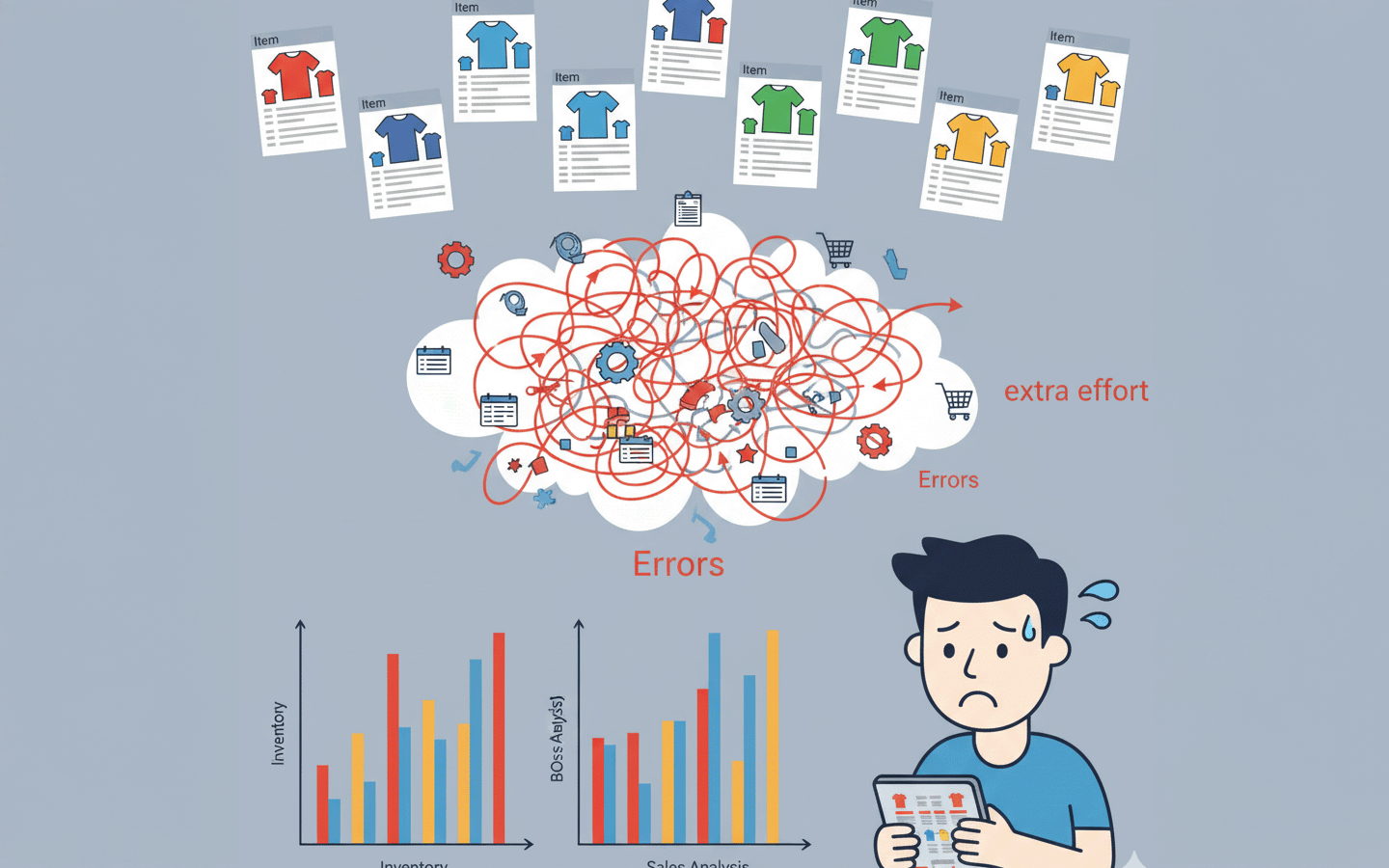
8 minCentralized management of size and color variations — How to use the item variant function
How to manage variations in size, color, and specifications of the same product using ERPNext? This guide explains the setup procedure and operational tips for the variant function, complete with screenshots.