
Trading companies' ERP utilization strategies — centralized management of multi-location warehouses, VIP pricing, and foreign currency transactions.
This article explains the convenient features of ERPNext.JP, which is specifically designed for trading companies. It supports multi-site warehouse management, VIP customer pricing, foreign currency transactions, and credit management with standard features plus Japanese specifications.
Introduction
Common challenges in system selection for trading companies include complex business requirements such as multi-site inventory management, customer-specific pricing, foreign currency transactions, and credit management. General accounting software and sales management systems are insufficient to cover all aspects, resulting in a constant stream of cases where companies are forced to rely on Excel or management dependent on individual employees.
Therefore, I would like to recommend: ERPNext.JP is.
Based on ERPNext, which has been implemented in over 30,000 companies overseas,
It has been customized to suit the business practices of Japanese trading companies.
Complex trading company operations
Its main features include standard functions plus Japanese specifications, enabling speedy implementation and efficient operation.
(The full source code is handed over as part of implementation — own it as your asset. Contact us for pricing.)
Key Features of ERPNext.JP
ERPNext.JP's particular strengths lie in: The four main elements are: "Multi-location warehousing × VIP customer average spending × Foreign currency transactions × Credit management".
This article will focus on the following features that are directly related to sales and customer management.
- 💡 Pricing Rule
- 👥 Customer Relationship Management (CRM/SRM)
- 💳 Credit Management and Sales Support Report
💴 Pricing Rule Feature
For trading companies, the ability to flexibly control "who they sell to, under what conditions, and for how much" is a lifeline for protecting their profits. ERPNext.JP's pricing rule function is a powerful mechanism that can meet those needs.
What you can do
Pricing rules allow you to automatically apply prices and discounts by freely combining conditions such as the following:
| Rules | Explanation |
|---|---|
| Applicable to | Item/Item Group/Brand |
| Partner Requirements | Customer, customer group, region, supplier, supplier type, etc. 👉 Setting special prices for VIP and large-volume clients is a breeze. New customers are also eligible simply by adding them to the group. |
| Specify Period | Specify period based on the start and end dates of special rules (If you set it up in advance, you'll never forget.) |
| Quantity Conditions | Tiered pricing based on quantity and amount |
| Coupons/Campaigns | You can link coupon codes and pricing rules. |
| Priority Control | If multiple rules overlap, priority will be used for automatic determination. |
| Overwrite or Discount | Overwrite the rate in the price list, or apply it as a discount rate |
👉 This eliminates the complex pricing conditions unique to trading companies, such as "special prices for VIP customers," "discounts only when purchased from supplier A," and "automatic 10% discounts during campaign periods." System automatically processes I will.
No tedious maintenance required! Dynamic management with AI and Python code.
However, implementing these kinds of rules tends to involve complex conditions such as "customer x quantity x region x period...". Traditionally, it would have been necessary to maintain price lists and master data endlessly, This is not the case at ERPNext.JP. .
Dynamic Conditions (Python Expressions)
👉 Dynamic conditions (Python expressions) allow you to manage conditions in your Python code.
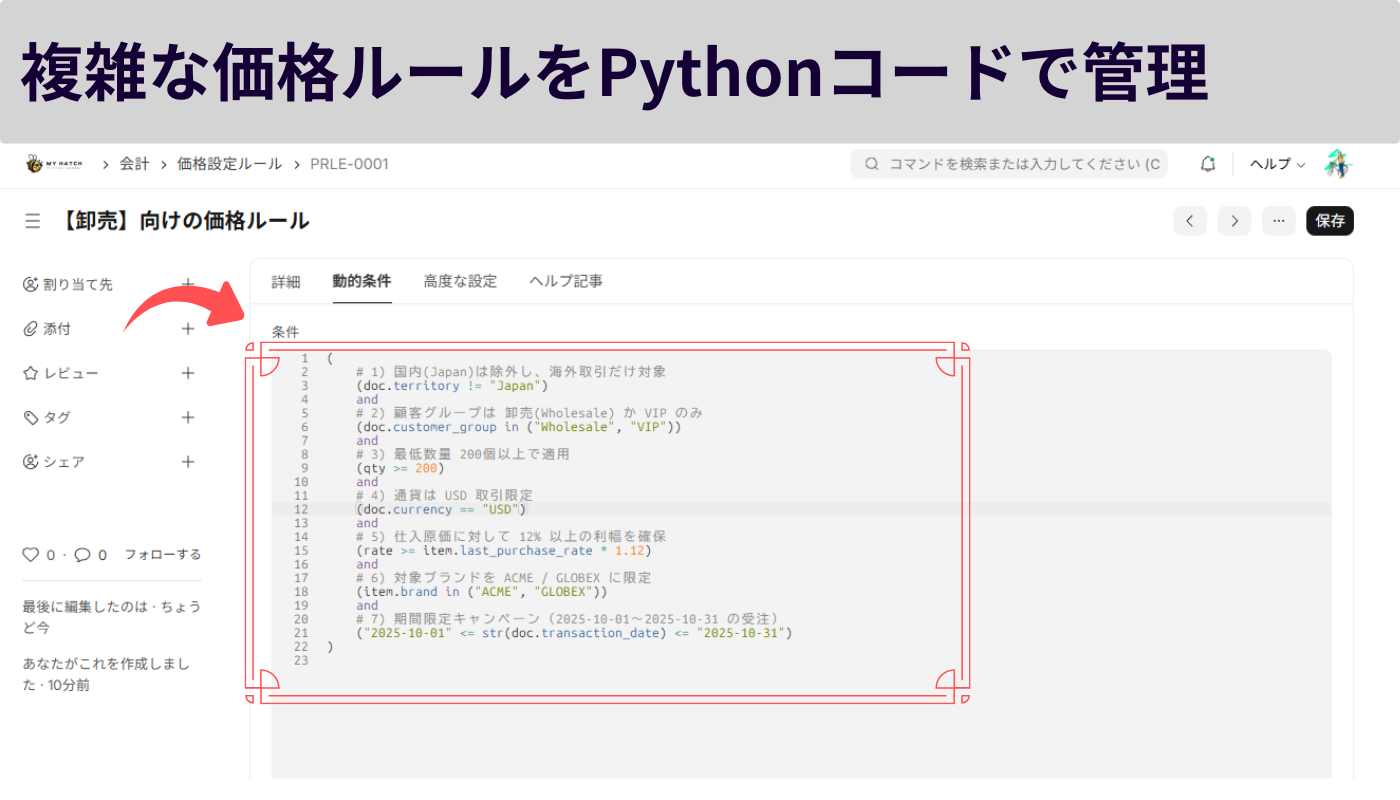
You just need to give instructions to the AI, and it will suggest code. If you provide the AI with Python code outlining the rules and what you want to do, it will return code that takes consistency and other factors into account.
👉 In short, even complex pricing strategies can be managed with AI × Python code, freeing you from the tedious task of updating price lists. The team can focus on "strategizing," and data entry tasks will be kept to a minimum.
👥 Customer Relationship Management (CRM) and Credit Management
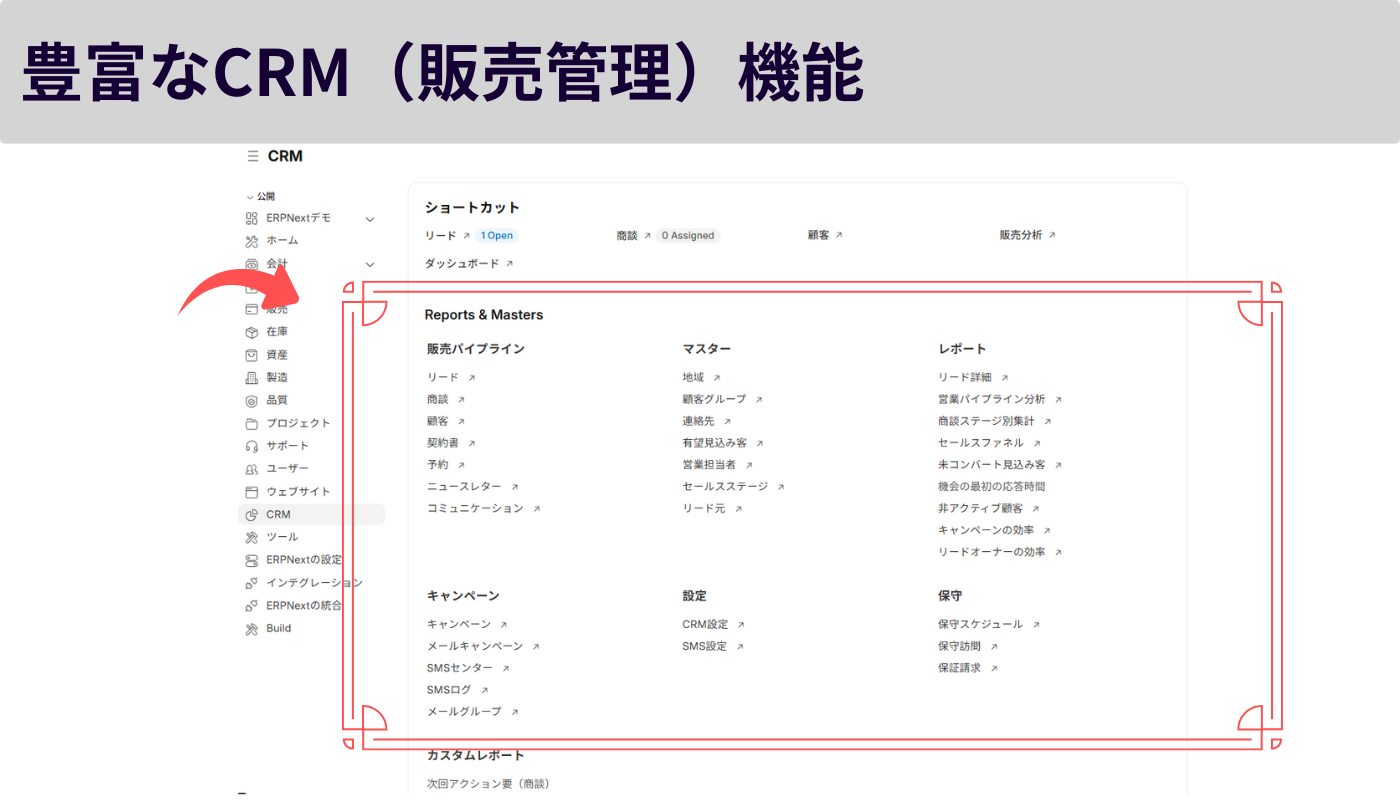
In the trading company business, properly managing "who to sell to and under what conditions" is key to protecting profits. ERPNext.JP's CRM functionality goes beyond a simple customer ledger, allowing for centralized management of pricing conditions, transaction history, and credit risk.
Furthermore, since past collection history and outstanding receivables can also be referenced, it enables a balance between "sales teams aiming to expand sales" and "accounting teams wanting to avoid risk".
Customer-Specific Credit Limits and Credit Management
A credit limit is set for each business partner, and an automatic alert is displayed when an order exceeds that limit. This prevents customer service representatives from unintentionally registering orders that exceed the credit limit, allowing the accounting and sales departments to manage risk using the same standards.
Centralization of customer information and management of sales conditions
- Automatically apply discount rates and special unit prices for each customer.
- Centralized management of conditions by customer group (VIP customers, large customers, general customers, etc.)
- Sales negotiations, quotes, and orders can be tracked chronologically on a per-customer basis.
👉 This makes it clear in the system who is trading under what conditions, which was previously reliant on Excel or verbal communication, thus preventing reliance on individual expertise.
📜 Sales Support Report
ERPNext.JP is not just a "data entry and done" system; it comes standard with a mechanism to connect data to the next sales action. By using reporting features that sales representatives and managers can utilize on a daily basis, you can drive both sales growth and procurement improvement.
Repeat purchase suggestion report based on sales history
Based on past sales history, the system automatically extracts items that "need to be restocked soon" and items that "have been purchased for X days." Sales representatives can obtain regular follow-up lists from the system, allowing them to never miss opportunities to make proposals and to make natural repeat offers.
- Example: "Company A, which purchased 100 units last time, has an average purchase cycle of 90 days → This week is the best time to propose repeat purchases."
- Example: "List products that have not been purchased in the past 3 months from the top 10 selling companies."
👉 Instead of relying on individual "intuition and experience," the system automatically generates proposal lists, creating an environment where salespeople can "act rather than think."
summary
ERP Next.JP is
What is required of trading companies "Multi-site warehousing × VIP customer unit price × Foreign currency transactions × Credit management" are covered by standard features, streamlining complex operations.
Furthermore, while leveraging the flexibility of OSS, it is optimized for Japanese business practices (payment reconciliation via Zengin CSV, support for 10%/reduced 8% consumption tax, and invoices compliant with the invoice system). This will enable us to create an ERP system that is truly usable by the field, at a price point that is easily accessible even to small and medium-sized trading companies.
ERPNext.JP offers more than just sales management and accounting software. This is an integrated ERP platform for trading companies that centralizes "inventory, order processing, customer management, accounting, and analytics."
👉 First, try it out with the free trial. We encourage you to experience firsthand how well it fits your company's trading operations.
Related articles
 7 min
7 minWhy ERPNext is effective for food processing and parts manufacturing companies — Industry-specific fit analysis
This article explains why ERPNext is particularly strong in the food processing industry (e-commerce, fax, and direct sales) and the automotive parts manufacturing industry, using a table that aligns implemented features with industry-specific challenges. Please use this as a basis for your implementation decision.
 8 min
8 minBreaking the Limitations of Excel Inventory Management — Eliminating the "Invisibility" of Inventory with ERPNext
Inventory discrepancies, taking a whole day to complete inventory counts... This article explains how ERPNext.JP solves these problems, from its overall functionality to the benefits of implementation.
 8 min
8 minBreak free from reliance on fax and email — Streamline transactions with a B2B order portal.
The reliance on fax and email for repeat transactions, the cumbersome process of sharing prices and delivery dates—we introduce a system that fundamentally transforms B2B order placement and receiving with ERPNext.JP's customer-only portal.