
What exactly is ERP? — Understand the difference from accounting software in 5 minutes
From the basics of ERP to its market share in Japan and the cost challenges of traditional ERP. We answer the question 'What is ERP, really?' with clear diagrams.
ERP (Enterprise Resource Planning) is a system that lets you manage a company's accounting, sales, inventory, HR, and many other operations in one place.
Think of it as the "nervous system" that connects the brain and heart of the company, letting information flow smoothly inside the organization. Because cash flow, stock levels, and how staff are working can all be checked on one screen, it becomes much easier to grasp the situation accurately.
How is it different from accounting or HR software?
In one sentence, ERP is different in that it "unifies the separate, department-specific tools into a single system".
Many companies first introduced standalone applications like accounting or HR software, then added more tools per department over time. Recently, SaaS services have made things more convenient, but they have also brought confusion:
- The same numbers get entered repeatedly
- Data conflicts between systems
- Nobody knows which app to use
These are familiar limitations of Excel and SaaS apps appearing once again, in a new shape.
By contrast, ERP manages accounting, HR, sales, inventory, and procurement as one continuous flow.
ERP eliminates these inconsistencies and unifies internal information. The result is less waste and smoother day-to-day operations.
ERP is a "mechanism that links the whole organization together", and its value is the same whether the company is large or small.
For these reasons, attention is shifting toward "ERPs that organize the whole business affordably", and adoption among small and mid-sized companies is increasing.

The ERP landscape in Japan
ERP went mainstream in Japan and globally in the 2000s. Back then, on-premises deployments (running on the company's own servers) were the norm, requiring significant time and money — making ERP largely a system for large enterprises.
In the 2010s, cloud ERP emerged. Lower upfront costs accelerated adoption, and subscription pricing became standard, lowering the barrier so small businesses and startups could adopt ERP. Going forward, AI and automation features are expected to be built in, evolving ERP into an even more convenient, efficient foundation for management.
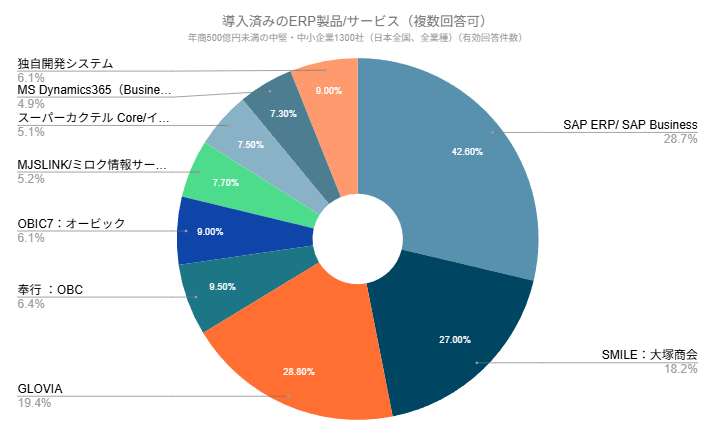
In the Japanese market, foreign giants such as
- SAP
- Oracle NetSuite
- Microsoft Dynamics 365
hold significant share. SAP in particular has been the world's number one for many years and is regarded as the representative ERP for large enterprises in Japan.
On the other hand, domestic mid-market software such as
- Kanjo Bugyo series
- SMILE (Otsuka Corporation)
are also widely used, with strong recognition and a loyal user base.
Challenges of traditional ERP
Even with so many options, traditional ERP still has significant problems.
- Implementation costs millions of yen
- Initial setup and operation are complex
- Adapting it to your way of working requires specialist engineers, adding more cost
As a result, ERP has long carried the image of being "a tool for large enterprises" and has remained out of reach for many small businesses.
Against this backdrop, demand has grown for an "ERP that is more affordable, ready to use quickly, and easy to fit to your business". One answer attracting attention is the open-source ERP ERPNext, used around the world. We cover ERPNext in detail in the next chapter.
Related articles
Related articles
 8 min
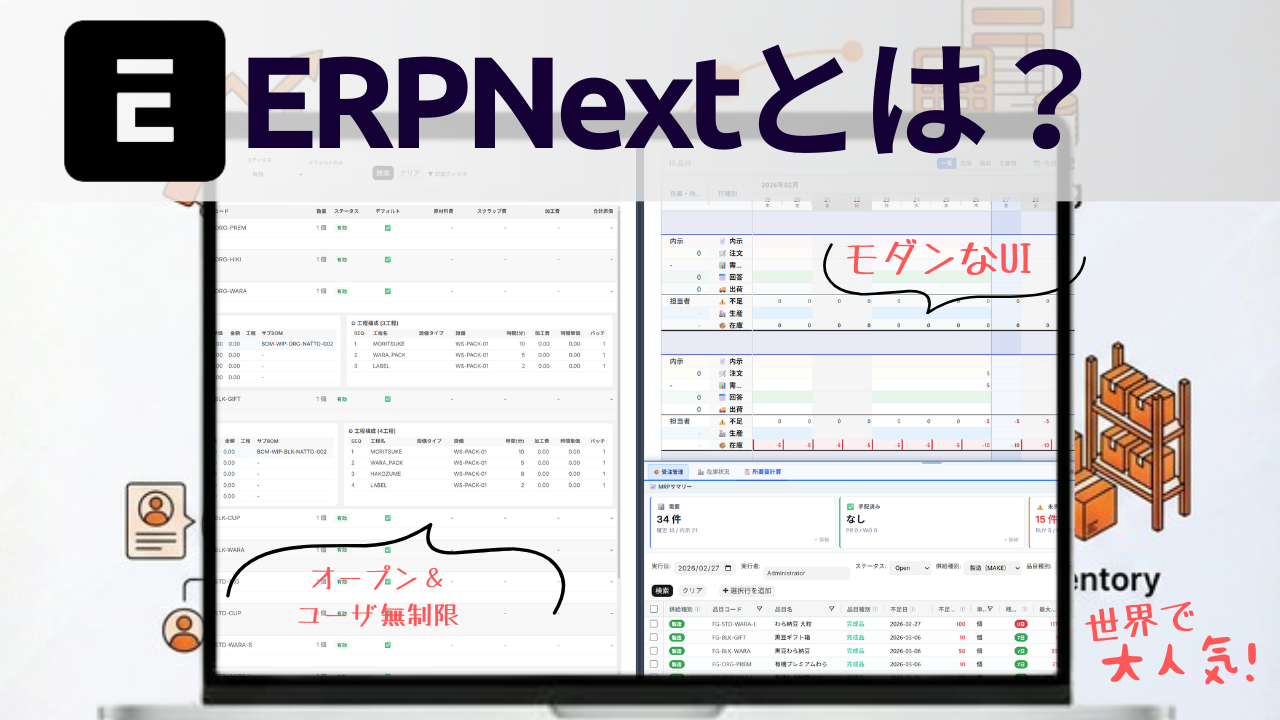
8 minUnderstand ERPNext in 3 minutes — the big picture of an open-source ERP
What ERPNext is and what business areas it covers, in three minutes. We cover module structure, how to read the official docs, and how to get started — pitched at first-time visitors.
 4 min
4 minHow to start — see the screen in 1 minute
Press the "Try now" button on this site and within 1 minute you'll get a login link to the demo. Three progressive stages — look only, evaluate after a meeting, and your own dedicated environment — let you try ERPNext as deeply as you want.
![What is Open Source ERP? A Thorough Comparison of its Mechanism, Benefits, and Top 5 Products [2026 Edition]](/images/documents/erp_eyecatch_google_d_1774357580557.png) 15 min
15 minWhat is Open Source ERP? A Thorough Comparison of its Mechanism, Benefits, and Top 5 Products [2026 Edition]
This guide provides a thorough explanation of how to choose the right open-source ERP system, from the fundamentals of open-source ERP to a comparison of the features and architectures of five major products (ERPNext, Odoo, etc.), and even covers Japan-specific implementation risks (invoices, vendor lock-in).