
What is ERPNext? — A complete view of the free open-source ERP
ERPNext is an open-source ERP that gives you premium-class functionality for free. Five-minute primer on key features, comparison with other products, pricing, Japanese-language support and adoption benefits — written for SMBs evaluating ERP.
What is ERPNext?
ERPNext is a free, open-source ERP that even small and mid-sized businesses can adopt. It carries the broad feature set of premium commercial ERP, but with zero license cost — that is its biggest strength.
In short, ERPNext is a new option that combines:
- The breadth of features found in premium ERP
- A truly open source — no surprise add-on fees
- An evolution driven by a global community
Market positioning — where does ERPNext sit?
ERPNext rivals premium ERP in breadth of business coverage and system-wide integration. At the same time, the cost of adoption and operation is closer to that of office software. This combination of "breadth × cost performance" is what sets ERPNext apart.
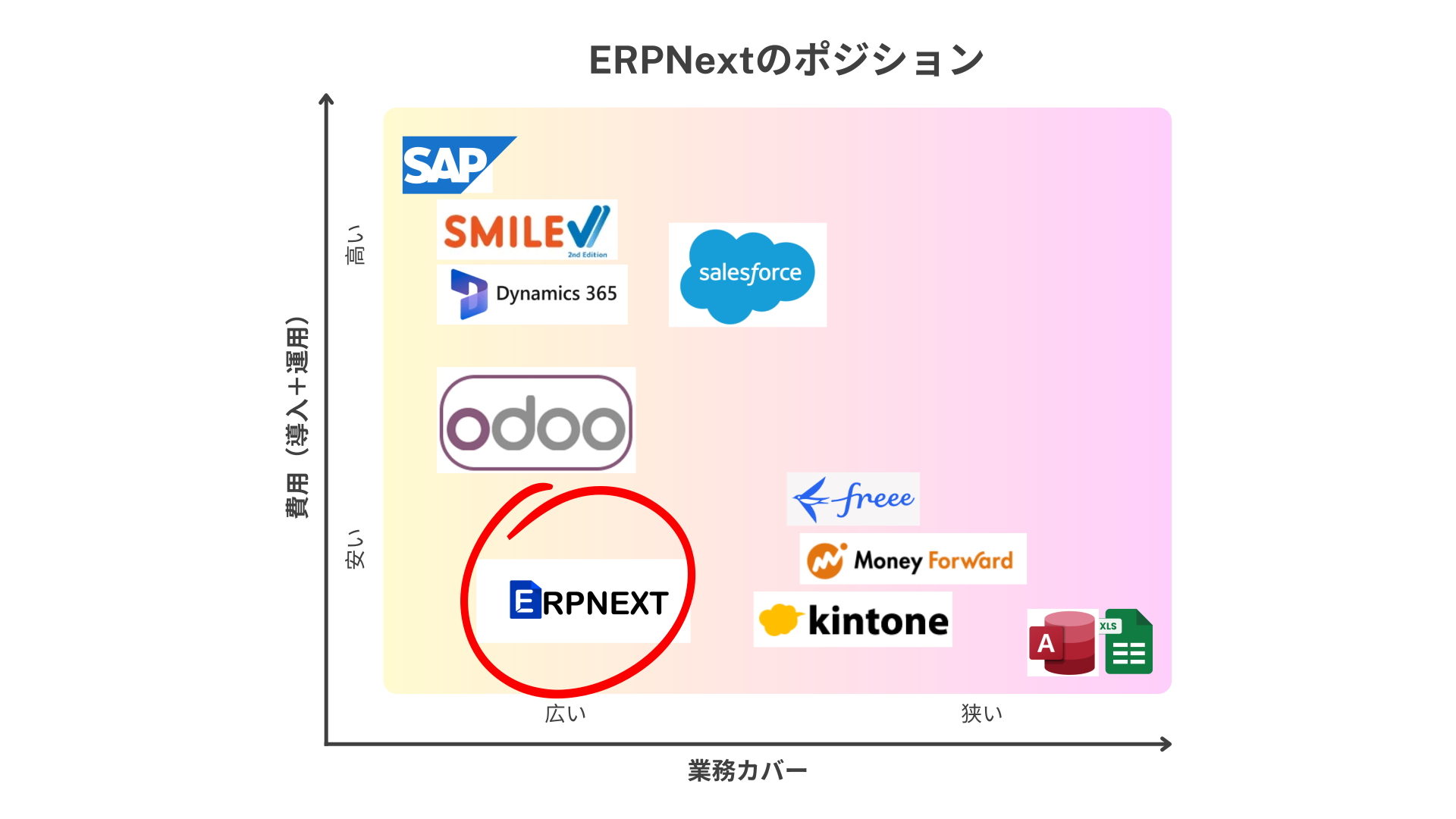
1) Premium-class breadth of features
As we covered, ERP varies widely in coverage and depth:
- OSS often offers "broad scope but hard to use"
- Commercial ERP offers "full features but expensive add-ons"
ERPNext, in contrast, is fully equipped from day one and completely free. There are no license fees, optional-module fees, or update fees — even though it ships frequent updates.
ERPNext's features — organized in three layers
ERPNext's functionality maps to three layers:
-
Core operational modules Budgeting, Sales / Customer management, Production, Manufacturing / Inventory, Purchasing / Costing, Accounting / Tax, BI
-
Operational support modules Flexible Workflows, CRM, HR / Payroll / Recruiting, Customization, Assignments / Comments, Print formats / Reports
-
Non-functional capabilities Automated backup, fine-grained permissions, security, responsive design
While many ERPs gate features behind "premium tiers" or "extra licenses", ERPNext gives you the full set up front.

2) Truly open source — no hidden fees
Unlike Odoo, where useful features are gated behind the paid version, ERPNext exposes the full feature set from the start. It is a genuinely open-source ERP that everyone can use on the same footing.
ERPNext is also developed under the GNU General Public License (GPL). Because of this, contributions are typically published, becoming shared assets of the community.
"Don't hoard useful features; share them." That is ERPNext's culture.
The result is a virtuous cycle:
- More users
- More requirements raised
- Developers ship features and publish them
- Even more users
This loop has kept ERPNext evolving at a pace comparable to commercial ERP.
If you want to dig deeper, see why you should choose open-source ERP.
👉 ▶ See ERPNext on the demo environment
3) An evolution driven by a global community
ERPNext is developed by an active community spanning India, Europe, North America and Asia.
- It has gathered 32,000+ stars on GitHub, growing into a globally-recognized open-source project
- Many community-contributed features are released for free, so users gain capability without extra cost
- Frappe Technologies maintains the core, while partners worldwide expand the ecosystem
In other words, adopting ERPNext means bringing the world's collective intelligence into your business.
Designed so customizations don't break
ERPNext also lets you keep your own modifications even as you upgrade.
- Add fields with custom fields
- Build your own features as custom apps
These mechanisms are designed not to clash with standard updates.
Think of it like rebuilding the foundations of your house safely, while keeping your custom-built furniture intact.
ERPNext pricing — is it really free?
The ERPNext software itself is completely free. There are no license fees, no per-user charges, and no feature-tier upcharges.
That said, the following operating costs apply:
| Cost item | What it covers |
|---|---|
| Server cost | Hosting on your own server or a cloud server |
| Initial setup / implementation support | Master setup, data migration, employee training, etc. |
| Maintenance / operational support | Updates, troubleshooting, operational consulting |
ERPNext.JP offers an implementation plan that bundles these. In most cases, total cost of ownership comes in at a fraction of commercial ERP.
Japanese-language support
"It's a non-Japanese ERP — can it really be used in Japanese?" is a question we get a lot.
- UI (admin screens): translated into Japanese; the major screens and menus are operable in Japanese
- Print formats / reports: invoice and delivery-note templates that match Japanese business practice
- Japanese documentation: ERPNext.JP provides a Japanese knowledge base and support
You don't need to worry about the typical "English-only" problem of overseas ERP.
ERPNext vs commercial ERP — quick comparison
A summary of the key differences:
| Item | ERPNext | Commercial ERP (SAP / Oracle, etc.) | Odoo |
|---|---|---|---|
| License cost | Free (GPL) | Several million yen / year and up | Community is free, Enterprise is paid |
| Feature scope | Full set as standard | Full set, with add-on modules priced separately | Community has feature limitations |
| Customizability | High (custom fields, custom apps) | Vendor-dependent (expensive) | High, but Enterprise recommended |
| Implementation timeline | Weeks to months | Six months to multiple years | Weeks to months |
| Japanese support | ✓ (translated UI) | ✓ (with Japanese subsidiaries) | △ (variable translation quality) |
| Recommended company size | SMB to mid-market | Large enterprise | SMB to mid-market |
For a deeper comparison with Odoo, see "ERPNext vs Odoo — head-to-head comparison".
Pros and cons of ERPNext
Pros
- Drastically lower cost — zero license, unlimited users
- Full feature set from day one — no "premium tier" upcharges
- Highly customizable — you control the source
- No vendor lock-in — you are not tied to a specific provider
- Frequent updates — continuous improvement from the community and the maintainer
Watch-outs
- You need to manage the server — either run cloud hosting or operate on-premises (→ solvable with ERPNext.JP's cloud plan)
- Japan-specific business practice — invoice system or e-tax bookkeeping rules may need customization
- Design matters at adoption — no-code/low-code is flexible, but bad initial design causes rework later
ERPNext.JP offers implementation and operational support to cover these.
Who should consider ERPNext?
ERPNext is especially suited to:
- SMBs that want to adopt ERP at low cost
- Companies bumping into the limits of Excel or accounting software — see the difference between ERP and accounting software
- Multi-site or multi-currency global companies
- Manufacturers and food processors wanting unified inventory and costing
- Trading and import companies wanting unified sales / purchasing / inventory
- Companies that want to avoid vendor lock-in and own their system
👉 Also see the state of ERPNext adoption in Japan.
What's next
"How can it be free yet so feature-rich?" The answer is in the open-source mechanism itself, and in the conviction of ERPNext's founder.
👉 In the next article, we explore why open source is especially valuable in today's environment.
Related articles
Related articles
![What is Open Source ERP? A Thorough Comparison of its Mechanism, Benefits, and Top 5 Products [2026 Edition]](/images/documents/erp_eyecatch_google_d_1774357580557.png) 15 min
15 minWhat is Open Source ERP? A Thorough Comparison of its Mechanism, Benefits, and Top 5 Products [2026 Edition]
This guide provides a thorough explanation of how to choose the right open-source ERP system, from the fundamentals of open-source ERP to a comparison of the features and architectures of five major products (ERPNext, Odoo, etc.), and even covers Japan-specific implementation risks (invoices, vendor lock-in).
 15 min
Q&A Guide
This is a comprehensive FAQ that organizes frequently asked questions about ERPNext and ERPNext.JP by implementation phase, theme, and actual challenges.
 9 min
9 minWho is Frappe, the company behind ERPNext? — Founding story and future vision
An introduction to Frappe Technologies, the developer of ERPNext: company profile, flagship services, and the founder's formative experience. Understanding their philosophy of 'democratizing ERP' will change how you evaluate the product.