
[Case Study Revealed] ERP Implementation Costs in Real Figures — a Fixed-Scope PoC, then Own the Entire Source Package (Open Source / ERPNext)
ERP implementation costs, in real figures. With heavy reuse of ERPNext's standard modules and thorough automation (CI/CD), total work time is roughly halved (600-700h to ~350h). A fixed-scope, fixed-price PoC lets you verify usability with real data, then own the entire source package outright. Contact us for pricing.
1. The bottom line: what you pay, and what you get
Major ERPs cost tens of millions to hundreds of millions of yen. ERPNext.JP's model is different: the entire source package is handed over, and you own the system as your asset. No license fees, no per-user billing.
With ERPNext.JP the full source package is handed over (for your own use). First, a fixed-scope PoC lets you confirm it truly works; once you're satisfied, we hand over the full source and 9 deliverables so the system becomes your own asset. From there, hands-on support and a maintenance subscription keep your in-house development going.
Separately, this article also details a fully custom, done-for-you build as a model case — an option for customers who don't have in-house engineers. By reusing ERPNext's standard modules, applying a fixed design pattern, and automating verification (CI/CD), we compress an implementation that would normally take 600-700 hours down to about 350 hours, and reinvest the time saved into quality and on-site adoption.
💡 The full pricing picture: fixed-scope PoC → source package handed over (own all assets, an in-house-development launchpad) → hands-on support and maintenance subscription as needed. Contact us for pricing.
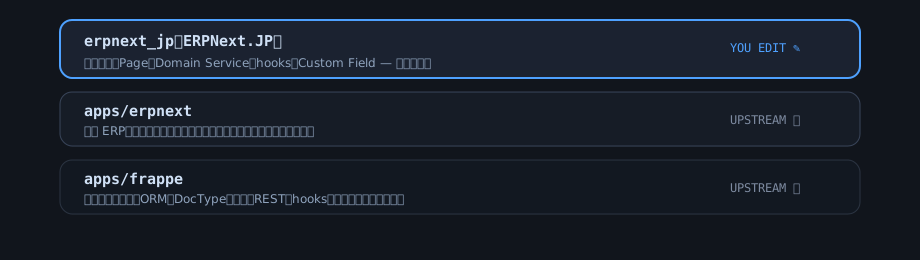
What exactly do you "own"? ERPNext.JP is a three-layer stack. You own the top layer (your customizations); the standard ERP and framework below stay upstream and keep updating.
2. [Real-world example] Model work breakdown for a fully custom, done-for-you build
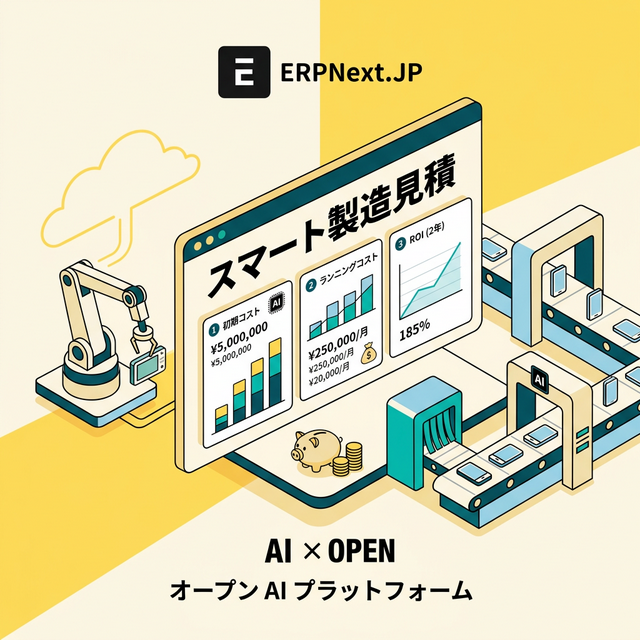
The example below is a representative work breakdown for a case where we build and roll out the system for you under a done-for-you engagement — an option for customers without in-house engineers. Contact us for pricing.
This time, we will introduce a model case of how ERPNext can be used to implement "building a foundation for automated order processing, production quantity calculation (MRP), and cost visualization", which is a common request from medium-sized and small manufacturing companies (with 50 to 100 employees).
■ Project Requirements (Scope)
- Target Operations: Order management, production planning (MRP), manufacturing performance management, cost management (material costs + process costs)
- Main requests:
- I want to automatically import order data from the e-commerce site.
- We want to semi-automatically calculate the required quantities of necessary parts based on order information (MRP).
- We want to know the exact manufacturing cost for each product.
- Duration: Approximately 3-4 months (shortened by reusing ERPNext's standard modules and a fixed design pattern)
■ Work Summary
| Time | Cost | |
|---|---|---|
| Phase 1: PoC (Proof of Concept, fixed scope) | approx. 100 hours | Fixed price (contact us) |
| Phase 2: Production Transition and Stabilization Support | 250 hours | Contact us for pricing |
| Total | 350 hours | Contact us for pricing |
With traditional ERP vendors, a custom build of this scale would typically cost 600-700 hours and tens of millions of yen. By reusing ERPNext's standard modules (much of it doesn't need to be built), reducing rework with a fixed design pattern, and making verification fast and safe with automation (CI/CD), we've reduced the total work time to approximately 350 hours (about half). The hours saved are reinvested into "quality" and "on-site adoption."
If you have in-house engineers and want to grow the system yourself, we recommend the source handover (own all assets) plus hands-on support and maintenance instead of this done-for-you build.
3. Why we can build it fast, affordably — and without breaking things
Bottom line: ERPNext specialists build with a fixed discipline of design and verification — which is why it's fast, affordable, and doesn't break. A build that normally takes 600-700 hours shrinks to about 350. The PoC is a fixed-scope, fixed-price engagement (contact us for pricing). The reason it stays cheap without losing quality is the way it's built (AI is used as a supporting tool, but the leads are expertise, patterns, and automation). In plain terms:
① We never edit the standard core — we add via "hook points"
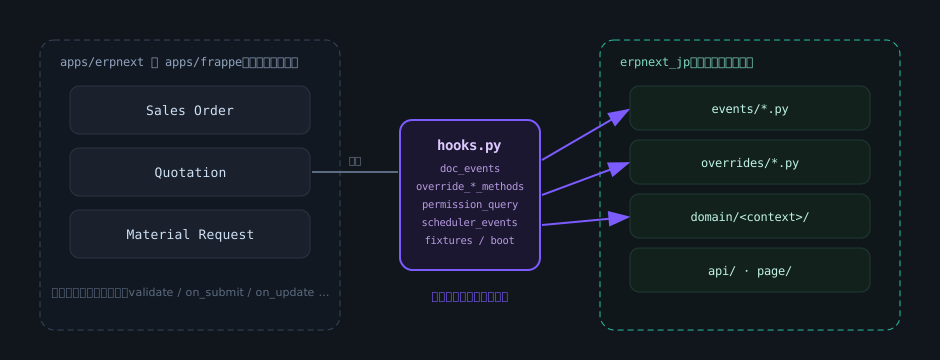
Editing the standard ERP core directly means you can't follow the upstream version upgrades, and things break with every update. ERPNext.JP never edits the standard core. Instead, your logic is registered into official extension points (hooks). The standard keeps updating; your customizations accumulate safely elsewhere — the golden rule of "never edit the standard core directly."
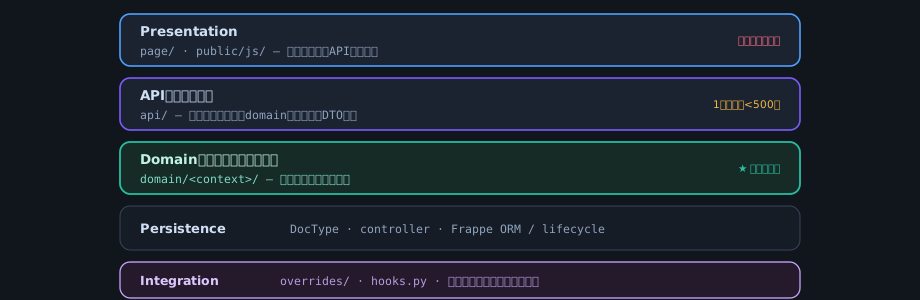
② Business rules live in the "right place" (layered design)
When display, entry points, and business rules are tangled together, fixing one thing breaks another. ERPNext.JP separates responsibilities into layers and concentrates business rules in a dedicated layer (Domain). Two payoffs: fixes are less likely to break other things, and the code isn't tied to one person — anyone can take it over.
③ A modern, robust foundation
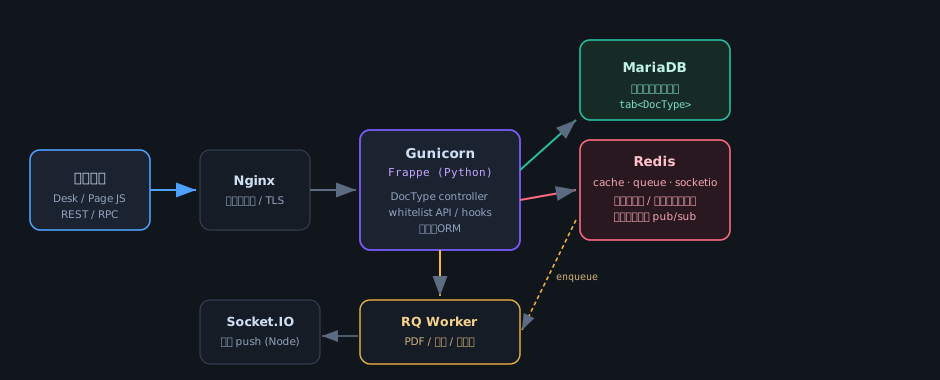
ERPNext.JP runs on a production-grade stack — browser → Nginx → Python (Gunicorn) → database (MariaDB), offloading heavy jobs to a queue (Redis) — the same architecture thinking as enterprise systems. It isn't "simplistic just because it's open source."
④ We don't mistake "it rendered" for "it works"
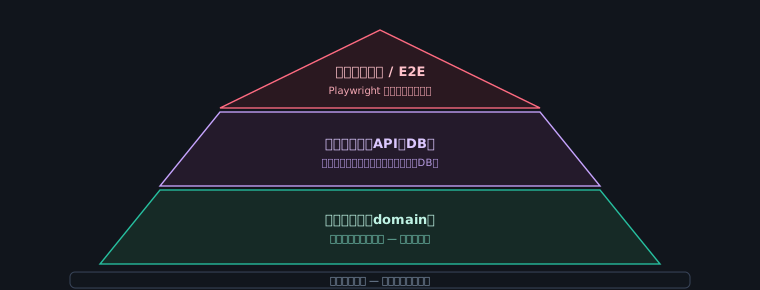
The scariest failure in software is something that used to work quietly breaking. ERPNext.JP stacks tests in layers and finally drives the real screen and database by hand. A "green" test can lie in three ways: a string existing in the source ≠ the screen actually renders; an element being present ≠ it works with the right data and permissions; a screen appearing ≠ the feature works (permission errors and post-save failures only show up when you actually operate it). That's why nothing breaks silently after delivery.
⑤ Thorough automation (CI/CD)
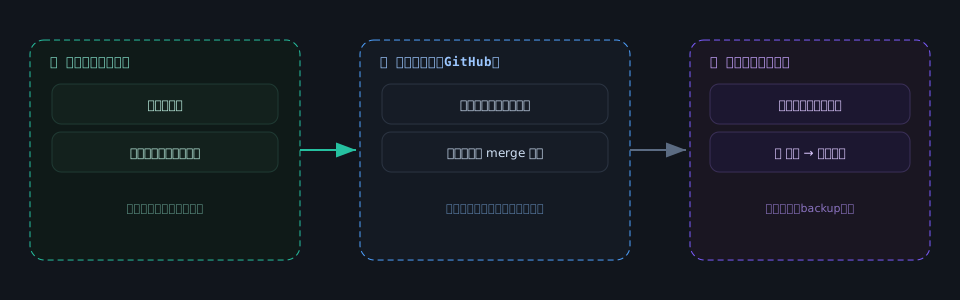
CI/CD means the moment you change code, it is automatically tested and released to production through a safe, fixed procedure. It lives in a pipeline (an automated flow), not in someone's runbook or memory. Locally, fast checks catch problems early; on the shared side, automatic gates and approval-based deployment structurally guarantee that "a broken change never reaches production."
What it produces:
- No key-person dependency: the procedure lives in the pipeline, not in one person's head — robust to handover and adding staff.
- Broken changes don't reach production: if a test fails, it can't even proceed to merge or deploy.
- Production release always requires human approval: accidental production deploys are forbidden by design.
- You can always roll back: with backups assumed, you can restore to the moment before a problem.
Deployment is a two-stage design: "staging is automatic, production is only after human approval." Production and staging are fully separated — different site, different database, different credentials.

Steps ①-⑤ — reuse of ERPNext's standards, a fixed design pattern, verification on the real system, and thorough automation. Stacked together, this is why the time is roughly halved without losing quality.
💡 The proof behind the trust: the design/verification discipline and the CI/CD described here are codified, not ad hoc. The source-package handover includes a Developer Guide and a CI/CD pipeline set as deliverables, so your own engineers can keep developing and operating at the same quality (you become self-sufficient). See our source-package guide.
4. A Fixed-Price "Proof of Concept"—Why Go to Such Lengths?
ERPNext.JP's fixed-price PoC (fixed scope) is not just a simple discount campaign. This is a Proof of Concept (PoC) phase to bring the success rate of implementation closer to 100%.
Why can we fix both the scope and the price? That's because, with ERPNext's speed and our specialists, you can reach a conclusion on whether it's truly usable in a short, well-defined engagement.
We will not compromise on our professional quality standards until our customers are absolutely certain that "this will work!" We set the PoC at a fixed price so that customers who are serious about implementation and our team can engage seriously with each other.
■ The fixed scope of the PoC (4 items)
- Fit & Gap analysis: Confirming how well your operations fit ERPNext.JP's standard features, identifying areas requiring additional customization, and improving the accuracy of estimates.
- Master data migration trial: You run the migration yourself, and we inspect and validate the results.
- Sample operation verification (3 scenarios): Confirm that core flows such as order placement to MRP (Material Requirements Planning) to actual manufacturing are functioning correctly.
- Standard feature confirmation: Verify standard features on a working environment.
In other words, you can see a working prototype rather than just a theoretical proposal, and determine whether it's right for your company.
💡 Key Point: The PoC phase is a fixed price with a fixed scope (contact us for pricing). After seeing a "working prototype" and confirming the fit, you decide whether to proceed.
5. Detailed explanation of the breakdown of costs (what is included in a standard 350 hours)
"Even with these efficiencies, there's a certain amount of time that simply cannot be cut when implementing an ERP system." -- That's what we believe.
This involves fine-tuning to suit on-site usability and thorough support after the system goes live.
We are releasing details of a more reliable model case in which, out of a total of 350 hours of work, the engagement starts with a fixed-price "PoC" (Proof of Concept), followed by 250 hours of "production migration and adoption support".
[Phase 1] Fixed-Scope Proof of Concept — A period to verify "whether it's truly usable."
| Fixed scope | Details |
|---|---|
| Fit & Gap analysis | Confirming how well your operations fit ERPNext.JP's standard features |
| Master data migration trial | You run the migration; we inspect and validate the results |
| Sample operation verification (3 scenarios) | Core flows such as orders, MRP and manufacturing records |
| Standard feature confirmation | Verify standard features on a working environment |
| Phase 1 Price | Fixed price — no extra fees thanks to the fixed scope (contact us) |
[Phase 2] Production Transition and Stabilization Support — A period to ensure successful implementation and stable operation in the field.
| Work Description | Estimated Time |
|---|---|
| Detailed Custom Development Complex report creation, e-commerce integration, custom UI implementation, etc. | 90 hours |
| Production Data Migration Data migration from the current system with data cleansing | 40 hours |
| Operation Training Key personnel training and thorough implementation in the field | 40 hours |
| Production Release Support On-site supervision immediately after launch, handling of irregular issues | 50 hours |
| Post-implementation improvement support Addressing "We want to do this more" requests that emerged after the system went live | 30 hours |
| Phase 2 Subtotal | 250 Hours |
*If you have specific requirements (such as complex API integration with external systems), a separate estimate will be provided. *If a site visit requiring business travel is necessary, actual transportation and accommodation expenses may be charged separately.
6. Why spend time on the "production transition" and beyond?
It is said that 80% of ERP implementation failures begin with rejection from the field immediately after release, with comments such as "It's not what we expected" or "It's difficult to use."
By reusing ERPNext's standards, a fixed design pattern, and automation, we dramatically reduced the time spent on the initial "configuration" and "code creation" phases. The time saved is then reallocated to the most crucial processes: "on-site implementation" and "improving usability."
This is intentional design.
- Complete requirements definition without any setbacks in a fixed-price PoC.
- In the "production phase", we refine it until the on-site team is satisfied.
Our approach isn't "implementation and then done," but rather "we'll support you until it's firmly established in the workplace." This is the investment allocation for a successful digital transformation (DX) proposed by ERPNext.JP.
Summary: "Fast, inexpensive, and high quality" — and "Until it takes root in the field"
| Strengths of ERPNext.JP | Content |
|---|---|
| Fast, non-breaking build | Reuse of ERPNext standards + a fixed design pattern + automation (CI/CD): reducing traditional 600-700 hours of work to 350 hours |
| Own-it flagship plan | Source package handed over (own all assets, an in-house-development launchpad) + optional maintenance subscription |
| Fixed-price proof-of-concept | A fixed-scope, fixed-price PoC (contact us for pricing) |
| Transparent Fees | A quote is provided before any work begins (contact us for pricing) |
| Thorough on-site support | Reallocate the time freed up to training and retention support |
ERPNext.JP will support you from consideration to implementation and stabilization.
"Can we implement an open-source ERP system?" ERPNext.JP (MyHaTch) can help with those kinds of problems.
- 🏭 We will listen to your company's business requirements and propose the optimal implementation plan.
- 🎯 Start with a fixed-price PoC (fixed scope), beginning with proof-of-concept using real data.
- 💰 The full source package is handed over (own all assets), with an optional maintenance subscription — no additional license fees. Contact us for pricing.
- 📄 Contact us for the full breakdown.
We at MyHaTch provide support from the implementation to the operation of ERPNext. We provide support tailored to the needs of small and medium-sized manufacturing companies in Japan.
- "What would the timeline and cost be like for our company?"
- "I'd like to try it out with a fixed-price proof-of-concept first."
- "I'd like to discuss how to proceed with the implementation."
👉 Start by exploring the feasibility of ERP implementation for your company with our free simulation. ERPNext.JP will fully support your company's first steps towards digital transformation.
Related articles
 8 min
8 minWhat is ERPNext? — A complete view of the free open-source ERP
ERPNext is an open-source ERP that gives you premium-class functionality for free. Five-minute primer on key features, comparison with other products, pricing, Japanese-language support and adoption benefits — written for SMBs evaluating ERP.
 9 min
9 minWho is Frappe, the company behind ERPNext? — Founding story and future vision
An introduction to Frappe Technologies, the developer of ERPNext: company profile, flagship services, and the founder's formative experience. Understanding their philosophy of 'democratizing ERP' will change how you evaluate the product.
![ERPNext vs Odoo Comparison [2026]: Differences, Cost, and Manufacturing Fit of Free ERP](/images/documents/solution/erp-comparison/erpnext-vs-odoo-hero.png) 12 min
12 minERPNext vs Odoo Comparison [2026]: Differences, Cost, and Manufacturing Fit of Free ERP
Compare ERPNext and Odoo on cost, licensing, Japanese localization, manufacturing features, and customizability. We break down Odoo Community/Enterprise vs ERPNext.JP for SMB ERP selection.