
Can you really implement your system using the free ERPNext? — An honest evaluation using a 45-item rating system.
ERPNext is globally recognized as a "free, open-source ERP," but there are areas where the original standard alone is insufficient to fully implement it in the operations of Japanese companies. This 45-item rating chart visualizes the gap between the ERPNext standard and ERPNext.JP, and honestly explains three common pitfalls in the age of AI development, as well as the perspectives necessary to move forward with implementation.
I'll give you an honest answer to the question, "Can't you go for free?"
"ERPNext" is a widely used open-source ERP worldwide. In Japan, too, there is a growing demand for a free ERP system that companies would like to try.
However, there is a question that anyone proceeding with the consideration will inevitably encounter.
"I understand it's free to run. But can we really proceed with implementation?"
In this article, we will visualize its scope using a 45-item rating chart and, along with the recurring failure patterns in the age of AI development, we will be as honest as possible.
Conclusion: Free is sufficient if you just want it to work. Implementing it properly requires a different approach.
If you just want to run it, it's truly free and starts up in 5 minutes. However, if you try to implement your internal business processes as they are, you will inevitably find areas that the standard ERPNext solution cannot handle.
- Just try it: Free and takes only 5 minutes.
- For full-scale operation: An extension group tailored to Japanese practical use is required (see the score table below).
- Is it faster to create it ourselves with AI?: You can get to a prototype. But "something that works" and "something that runs in actual business" are two different things.
For those who want to get started first
A hands-on guide to get you up and running in 5 minutes is available in a separate article. It covers everything from installing Docker Desktop to using the Japanese UI, written in a way that even those unfamiliar with IT can easily follow.
👉 ** [Free & Open Source] How to set up ERPNext in Japanese in 5 minutes — ERPNext.JP Starter released **
This article will address what comes next—Can we actually proceed to implementation after getting it working?
[Main Topic 1] How far does the free service extend? — A 45-item rating chart
ERPNext is free and takes only 5 minutes to get started. However, when you try to implement it in your company's operations, a gap becomes apparent between the original standard and Japanese practical applications.
We have compiled the extensions that we have actually implemented as ERPNext.JP into a 45-item rating chart, comparing them to the standard features of the original ERPNext.● However, "it can be handled with the original standard,"★ "Enhancements added with ERPNext.JP", These features are designed for use with tablets/smartphones.
| 項目 | 標準 | JP | 📱 |
|---|---|---|---|
| 営業・見積 | |||
| 工程ごと見積 | ○ | ★★★ | ─ |
| 松竹梅 3案比較 | ─ | ★★★ | ─ |
| モバイル見積 | ─ | ★★★ | |
| テンプレ/過去引用 | ◐ | ★★★ | ─ |
| 数量別単価マトリクス | ○ | ★★★ | ─ |
| 受注・需給計画 | |||
| 受注/内示/出荷統合 | ○ | ★★★ | ─ |
| 内示と確定の差分管理 | ─ | ★★★ | ─ |
| 販路別の生産計画 | ◐ | ★★★ | ─ |
| 所要量計算(MRP)・設備負荷 | |||
| 複数受注 一括MRP | ○ | ★★★ | |
| ワンクリック発注/指図 | ○ | ★★★ | ─ |
| 多階層BOM 不足提案 | ○ | ★★★ | ─ |
| 設備負荷ガント(拡張中) | ◐ | ★★★ | |
| 製造実績・現場 | |||
| 設備ログイン式 実績入力 | ◐ | ★★★ | |
| 工程/ロット単位 実績 | ○ | ★★★ | |
| スキャナ/Fキー 実績 | ─ | ★★★ | |
| 自動設備割当+進捗ガント | ◐ | ★★★ | |
| 進捗ガント↔Excel連携 | ─ | ★★★ | ─ |
| 在庫・トレーサビリティ | |||
| 容器ベース 仕掛管理 | ○ | ★★★ | |
| ロット親子追跡 | ◐ | ★★★ | ─ |
| モバイルピッキング/出荷 | ○ | ★★★ | |
| 項目 | 標準 | JP | 📱 |
|---|---|---|---|
| 購買・発注・承認 | |||
| 不足→発注 一気通貫 | ○ | ★★★ | |
| 重複発注 自動防止 | ◐ | ★★★ | |
| 重複アイテム行 自動統合 | ─ | ★★★ | ─ |
| 過去単価 自動参照 | ─ | ★★★ | ─ |
| 発注メール 自動下書き | ◐ | ★★★ | ─ |
| 仕入先別 一括送信 | ─ | ★★★ | ─ |
| マスタ未登録品 購入依頼 | ─ | ★★★ | |
| 金額・予算連動 承認 | ○ | ★★★ | |
| 連携・取込 | |||
| EDI取込(取引先別) | ─ | ★★★ | ─ |
| FAX OCR(標準なし) | ─ | ★★★ | |
| EC/モール 自動取込 | ─ | ★★★ | ─ |
| 原価・会計 | |||
| 月次単位 実際原価【月次決算】 | ◐ | ★★★ | ─ |
| 仕掛品・工程別原価 | ○ | ★★★ | ─ |
| 経理ハブ(債権/債務/締め) | ○ | ★★★ | ─ |
| 案件・プロジェクト | |||
| 案件単位 原価/予実/図面 | ○ | ★★★ | |
| 帳票 | |||
| 日本語 帳票59種 | ─ | ★★★ | ─ |
| 非機能(UX/運用/品質) | |||
| 業務専用画面 約135 | ─ | ★★★ | |
| タブレット/モバイル画面群 | ◐ | ★★★ | |
| 権限/監査/自動化 | ○ | ★★★ | ─ |
| 自動テスト219本 | ─ | ★★★ | ─ |
| CI/CD(拡張中) | ─ | ★★★ | ─ |
| 操作マニュアル12種 | ─ | ★★★ | ─ |
These aren't just "nice-to-have" features; they are essential for fully integrating your business processes into ERPNext. If you stick to the standard configuration, you'll inevitably hear complaints from the field like, "We could do this with the old system."
[Main Topic 2] An honest answer to the question, "Wouldn't it be faster to create it with AI?"
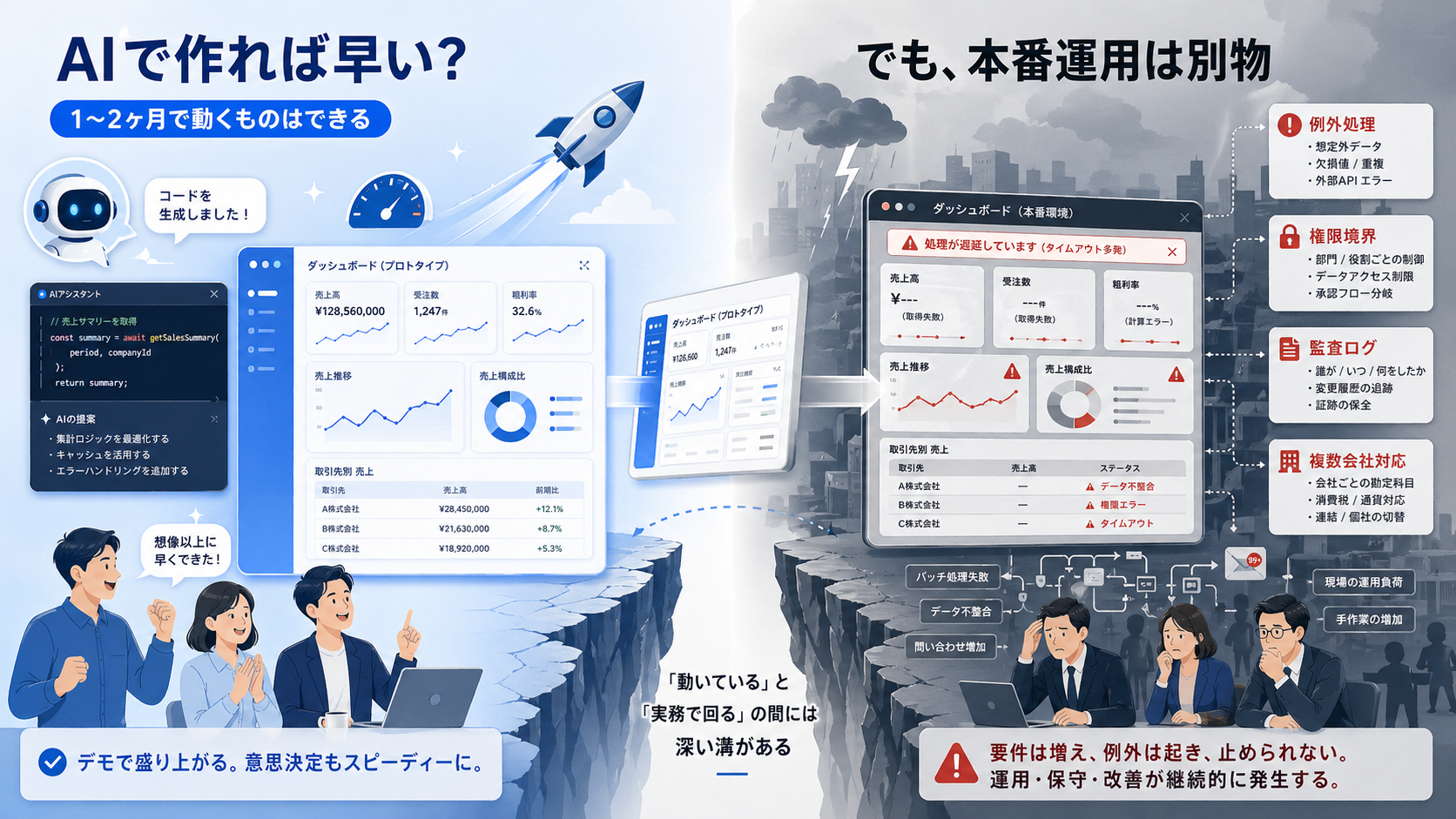
In recent years, the accuracy of code generation AI has reached a level that is sufficient for practical use, and it is now possible to carry out individual extensions of ERP systems using AI pair programming. That is a fact.
However, in our experience consulting with clients, we have observed certain patterns of failure that we see repeatedly.
Pattern 1: Prototype Scam
We had AI write the code, and we were able to create something that "works" in one to two months. The internal demo also passed. However, the moment it's put into production, exception handling, permission boundaries, audit logs, and support for multiple companies all fall apart. There's a much deeper gap than you might imagine between something "being in motion" and "actually running smoothly in practice."
Pattern 2: The accumulation of individual extensions leads to overall collapse
Each time a request comes in, we expand it locally. After six months, the rules differ from screen to screen, and no one can grasp the overall consistency anymore. Making changes will cause other parts to break, and the pace of repairs will slow down considerably. The value of an ERP system is determined not by the number of screens, but by its consistency.
Pattern 3: The person in charge leaves, creating a black box.
Only one person in the company knows the details. The moment that person is transferred or leaves the company, the individual extensions written by the AI become a black box. We receive inquiries several times a year from people who say they can't maintain their existing code and end up having to rewrite it from scratch.
Requires a deeper level of design than simply creating "moving objects."
ERPNext is powerful. However, to fully implement business operations, it requires a deeper level of design than just a "working" system—exception handling, permission boundaries, audit trails, and methods for maintaining consistency.
That's why, if you're going to fully implement ERPNext, starting from a launchpad that has been honed through over a year of real-world testing and multiple successful implementations is ultimately the shortest route.
One of the launching pads for this is ERPNext.JP, which is operated by us at MY HATCH.
If you're at the stage where you want to specifically consider whether it's suitable for your company's operations or where to start, please feel free to contact us. github@erpnext.jp
The Value of MY HATCH — A Partner for "Understanding Implementation" in the AI Era
MY HATCH doesn't just deliver the source code and consider the job done. Our core value lies in ensuring that the solution is fully implemented in your operations. Specifically, we support you at a layer above the source code.
- Incorporating on-site innovations outside of the system
- Defining the boundaries of integration with existing tools such as Excel.
- Defining requirements for the factory floor (who inputs what and when)
- Switching between old and new systems requires meticulousness and experience.
- Support during the initial period of confusion after the transition
- Managing requests for repairs (deciding whether to proceed, not proceed, or postpone).
ERPNext is the "ultimate, most flexible ERP." That's why, to fully implement that freedom, you need a supportive partner. For customers who say, "We want to do it ourselves, but we're unsure how far we can go," our role is to get them right up to the final meter.
In recent years, it has become possible for anyone to write custom extensions using AI. However, the danger of releasing them into production without understanding them has definitely increased. We want to be a company that deeply understands Frappe/ERPNext and takes care of everything from design and authorization to audit trails and maintenance. With that in mind, we have released this starter.
"We'd like to try ERPNext in-house."
Assessment of suitability for business operations, scope of customization, estimated scale, etc.
Why not start with a 30-minute online consultation?
- Try touching it first: How to launch ERPNext in Japanese in 5 minutes
- Try it on GitHub: github.com/maihatch/erpnext-ja-starter (Stars welcome)
- Consultation: github@erpnext.jp
Notice Regarding Trademarks and Licenses "ERPNext" and "Frappe" are trademarks of Frappe Technologies Pvt. Ltd. This article and repository are a community project unrelated to Frappe Technologies and are not an official app.
Related Articles
- [Free & Open Source Software] How to set up ERPNext in Japanese in 5 minutes - Launching pad for in-house ERP development — ERPNext.JP source package - In the age of AI, ERP is shifting from "buying" to "creating" — the shortest route.
Related articles
![[Free & Open Source] How to set up ERPNext in Japanese in 5 minutes — ERPNext.JP Starter released (v16, Docker, MIT)](/images/documents/erpnext-jp-starter/hero-5min.png) 6 min
6 min[Free & Open Source] How to set up ERPNext in Japanese in 5 minutes — ERPNext.JP Starter released (v16, Docker, MIT)
ERPNext's Japanese starter, "ERPNext.JP Starter," is now available on GitHub. It launches Frappe/ERPNext v16 in 5 minutes using a Docker container, includes 17,739 translation dictionary entries tailored to Japanese business practices, and is licensed under the MIT license. Compatible with both Windows and Mac, it provides easy-to-follow instructions even for those unfamiliar with IT.
![Average Costs for ERP Implementation [2026 Edition]: Includes a Comparison Table of All 11 Products](/images/documents/implementation/erp-cost-guide/erp-cost-guide-hero.png) 7 min
7 minAverage Costs for ERP Implementation [2026 Edition]: Includes a Comparison Table of All 11 Products
The typical cost of implementing an ERP system in a manufacturing company with 30 employees is between 2 million and 15 million yen over 5 years (Total Cost of Ownership). This guide includes a comparison table of three types (cloud, on-premise, and open-source), a cost list for 11 major products, and a 15-item checklist to prevent budget overruns.
 7 min
7 minERPNext.JP Implementation Cost Guide | Own the Source as Your Asset
We reveal ERPNext.JP's cost structure: the full source code is handed over so you own the system as your asset. Includes a comparison of four major ERP systems. Contact us for pricing.